
ARM vs x86 for Embedded Vitals Processing: 2026 Performance Benchmarks
2026 benchmarks for ARM vs x86 embedded vitals processing, covering rPPG workloads, power draw, NPUs, thermals, and kiosk deployment tradeoffs.
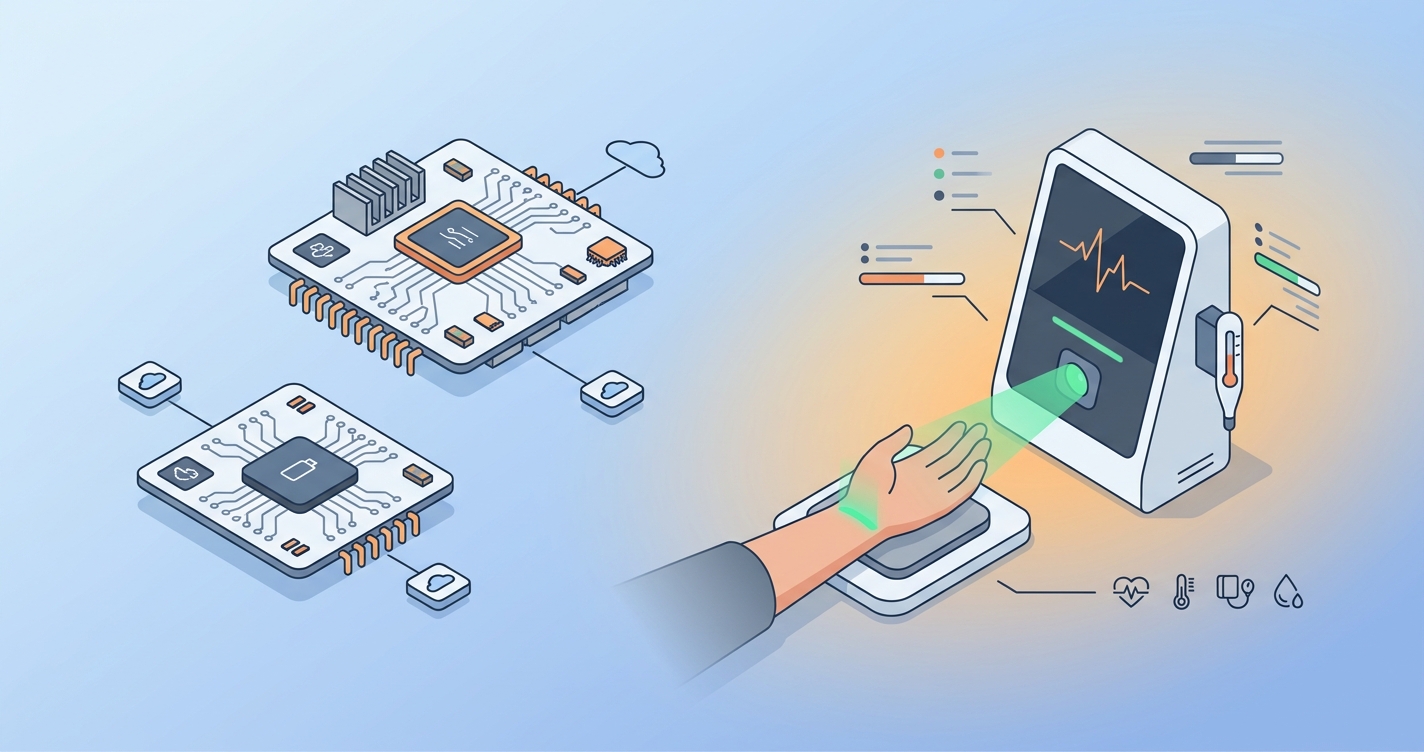
ARM vs x86 embedded vitals processing benchmarks have become much more relevant over the past year because embedded health devices are no longer judged only on whether a model runs. Buyers now ask a less glamorous question: what happens after eight hours in a kiosk enclosure with a live camera, local logging, a touchscreen UI, and a queue of actual people. That is where the architecture split matters. ARM still has a real edge in efficiency and thermal simplicity, while x86 keeps winning when teams need broader software compatibility, richer peripherals, and more room for mixed workloads.
"The designed pipeline has high performance, scalability, and low variance among the different platforms with an average accuracy of 96.7%." — M. A. M. Al-Quraan, M. A. Al-Qaralleh, and A. M. Al-Qaralleh, IEEE Access, 2023
ARM vs x86 embedded vitals processing benchmarks: what teams are actually measuring
The benchmark story is not really about CPU architecture in isolation. Embedded vitals systems combine camera capture, image signal processing, face tracking, signal extraction, filtering, estimation, UI rendering, local storage, and API handoff. A processor can look fast in a synthetic test and still behave badly in a real kiosk if it runs hot, pulls too much power, or shares memory poorly with the camera pipeline.
That is why the most useful 2026 comparison has four parts:
- sustained inference and video-processing performance
- performance per watt under long duty cycles
- thermal behavior inside compact enclosures
- compatibility with the software stack around the measurement engine
Al-Quraan, Al-Qaralleh, and Al-Qaralleh's 2023 IEEE Access benchmark is still one of the more useful reference points in this category because it tested contactless heart-rate measurement on ARM-based embedded platforms rather than discussing edge AI in the abstract. Their result was not that one board magically solved the problem. It was that embedded rPPG can run well when the system is balanced.
Rouast, Adam, Chiong, Cornforth, and Lux in Artificial Intelligence in Medicine (2018) made the same point from the algorithm side. They described rPPG performance as highly sensitive to lighting, motion, and camera quality. In plain English, hardware selection changes signal quality before anyone gets to brag about AI throughput.
| Benchmark area | ARM result in practice | x86 result in practice | What it means for embedded vitals |
|---|---|---|---|
| Performance per watt | Usually better | Usually lower | ARM fits fanless kiosks and thermally constrained devices more easily |
| Raw software flexibility | More specialized | Broader | x86 handles desktop-class middleware, Windows, and peripheral-heavy stacks better |
| NPU availability in 2026 devices | Strong and common | Improving fast | Both can run local AI, but ARM still tends to package efficiency more cleanly |
| Thermal behavior | Easier to manage | More enclosure-sensitive | Long duty cycles favor ARM unless x86 cooling is designed honestly |
| Peripheral and legacy support | Good but platform-specific | Excellent | x86 still wins many retrofits and enterprise kiosks |
Why ARM still leads many single-purpose vitals devices
I keep coming back to a simple pattern: if the product is a focused appliance, ARM is usually the safer first look. That is especially true for guided screening kiosks, embedded tablets, bedside terminals, and wall-mounted stations where the workflow is narrow and the enclosure budget is tight.
The Al-Quraan benchmark helps explain why. Their ARM-based contactless heart-rate pipeline reached 96.7% average accuracy while keeping execution practical on embedded hardware. That matters because it undercuts the lazy assumption that meaningful vitals processing automatically requires desktop-class silicon.
It also lines up with the newer AI hardware cycle. AMD says its Ryzen Embedded 8000 series offers up to 16 TOPS from the integrated XDNA NPU and up to 39 TOPS combined across NPU, GPU, and CPU. Those are not small numbers anymore. ARM-side embedded platforms are no longer just the low-power option. In many devices, they are now the efficient AI option.
For embedded vitals, that usually shows up in three ways:
- lower steady-state power draw
- simpler thermal design in slim enclosures
- cleaner economics for always-on deployments
That last point matters more than spec sheets suggest. A kiosk that stays on all day in a clinic lobby, pharmacy, or intake desk does not just need enough compute. It needs predictable compute.
Where ARM benchmarks look strongest
ARM tends to benchmark best when the device has:
- one main camera
- a guided user flow
- local inference with modest multitasking
- limited fan space or preference for passive cooling
- a cost target that punishes overbuilt compute
Kobayashi, Nakao, and colleagues in Sensors (2021) found that front lighting above 500 lux and frame rates above 30 fps materially improved conditions for HRV-oriented rPPG measurement. That finding sounds like a camera note, but it is also a processor note. Once the device has to sustain those capture conditions while rendering a UI and storing logs, wasted watts turn into heat very quickly.
Why x86 still matters in 2026 benchmark decisions
x86 did not disappear just because embedded NPUs became fashionable. It is still the more forgiving architecture when device teams need a broad software stack, lots of I/O, or enterprise deployment habits that already assume Windows or standard x86 Linux tooling.
Intel's first Core Ultra generation brought a dedicated NPU with roughly 11 to 11.5 TOPS, which changed the equation for edge kiosks. That is not enough to erase ARM's efficiency advantage, but it is enough to make modern x86 systems much more credible for local AI workloads than older mini PCs were.
The practical case for x86 usually looks like this:
- the kiosk already uses desktop-style middleware
- the device needs scanners, printers, badge readers, or multiple cameras
- the buyer wants familiar IT management and broader driver support
- the user interface is heavier than a simple screening workflow
- the enclosure has enough volume for active cooling
This is where benchmark charts can mislead. x86 often loses the performance-per-watt argument, but it wins the total-workload argument more often than people admit. If the system is really a self-service workstation with a vitals module attached, the broader compatibility can outweigh the power penalty.
| Deployment type | Better ARM fit | Better x86 fit |
|---|---|---|
| Fanless screening kiosk | Yes | Sometimes |
| Embedded tablet or smart display | Yes | Rarely |
| Existing enterprise kiosk retrofit | Sometimes | Yes |
| Peripheral-heavy intake station | Sometimes | Yes |
| Multi-app clinical workstation | Rarely | Yes |
| Fixed-purpose OEM health appliance | Yes | Sometimes |
The benchmark gap narrows once NPUs enter the picture
One reason the ARM vs x86 debate feels different in 2026 is that both sides now ship silicon with local AI acceleration. A few years ago, teams often compared efficient ARM devices against general-purpose x86 boxes. That was never a fair fight. The comparison now is more interesting because both architectures can offload parts of the inference pipeline.
Still, the NPU does not settle everything.
A vitals device spends a lot of time outside the neural network itself. Camera ingest, color normalization, face tracking, buffering, encryption, and UI work all sit around the model. That is why architecture-level benchmark claims can drift away from real device behavior.
In embedded vitals systems, the useful question is not "How many TOPS does it have?" It is closer to "How much of the entire session can it complete locally without stalling, overheating, or bloating the BOM?"
A more honest 2026 benchmark framing
Here is the cleaner way to think about it:
| 2026 benchmark question | ARM answer | x86 answer |
|---|---|---|
| Can it run contactless vitals locally? | Yes | Yes |
| Can it do that with lower power? | Usually yes | Sometimes |
| Can it handle broader legacy software stacks? | Sometimes | Usually yes |
| Is it easier to cool in a slim enclosure? | Usually yes | Usually no |
| Is it easier to drop into existing enterprise kiosk fleets? | Sometimes | Usually yes |
| Is it the best value for one well-defined workflow? | Often yes | Less often |
That is less dramatic than saying one architecture won. It is also closer to what integrators deal with.
Industry applications for ARM and x86 embedded vitals platforms
Clinical kiosks and waiting-room stations
These devices usually benefit from ARM when the workflow is mostly guided capture plus local estimation. They benefit from x86 when the station also has to run a broader check-in environment with multiple peripherals and enterprise software dependencies.
Smart displays and bedside terminals
This is still ARM territory most of the time. Lower power, smaller boards, and manageable thermals are hard to beat when the display itself is the enclosure.
OEM medical appliances
If the manufacturer controls the whole stack, ARM often wins because the system can be tuned around one use case. That lowers service burden and helps hold the thermal envelope steady.
Enterprise retrofits
I would not force ARM into a project that is really an x86 refresh. If the existing kiosk fleet already runs x86 software, speaks to legacy peripherals, and is maintained by standard endpoint tooling, x86 can be the cheaper architectural choice even if it is not the most elegant one.
Current research and evidence
The strongest evidence here still comes from combining embedded benchmark work with rPPG systems research.
Al-Quraan, Al-Qaralleh, and Al-Qaralleh showed in 2023 that ARM-based embedded platforms can deliver practical contactless heart-rate processing with 96.7% average accuracy across tested systems. Rouast and colleagues in 2018 documented why camera quality, motion, and lighting remain first-order variables in remote photoplethysmography. Kobayashi and colleagues in 2021 added a more concrete deployment threshold, showing that front lighting above 500 lux and frame rates above 30 fps improve HRV-oriented capture conditions.
On the silicon side, official vendor specs tell the rest of the 2026 story. Intel's Meteor Lake-era Core Ultra platform brought an NPU in the roughly 11 to 11.5 TOPS range. AMD's Ryzen Embedded 8000 family pushed embedded AI further, with up to 16 TOPS on the XDNA NPU and up to 39 TOPS across the full heterogeneous package. Those figures do not prove a medical workflow by themselves, but they do show that both ARM-leaning and x86-leaning embedded systems now have credible on-device AI acceleration.
| Source | Year | Useful takeaway |
|---|---|---|
| Al-Quraan, Al-Qaralleh & Al-Qaralleh, IEEE Access | 2023 | ARM embedded platforms can support contactless heart-rate processing with strong average accuracy |
| Rouast et al., Artificial Intelligence in Medicine | 2018 | Lighting, motion, and camera quality remain decisive system variables for rPPG |
| Kobayashi et al., Sensors | 2021 | 500+ lux front lighting and 30+ fps capture improve HRV-oriented measurement conditions |
| Intel Core Ultra platform disclosures | 2024 | Modern x86 edge systems now include dedicated NPUs around 11-11.5 TOPS |
| AMD Ryzen Embedded 8000 disclosures | 2024 | Embedded AI platforms on the ARM side now offer up to 16 TOPS NPU performance |
The future of ARM vs x86 for embedded vitals processing
I do not think 2026 ends with one architecture replacing the other. The split is becoming clearer instead.
ARM will keep dominating focused devices that need low power, compact boards, and stable all-day thermals. x86 will keep holding ground in mixed-workload stations, retrofits, and enterprise deployments where compatibility matters as much as efficiency. The more interesting change is that both sides are now credible for local AI. That means the next round of benchmark decisions will focus less on whether inference is possible and more on enclosure honesty, camera stability, and whole-system cost.
That is probably healthy. Embedded vitals products are maturing. Buyers should be asking what happens after deployment, not what happened in a vendor demo.
Frequently Asked Questions
Is ARM faster than x86 for embedded vitals processing?
Not in every case. ARM is usually stronger on performance per watt, while x86 is often stronger when the system has a heavier software stack, richer UI, or more legacy integration requirements.
Why do ARM platforms show up so often in contactless vitals devices?
Because many of these devices are focused appliances. ARM platforms usually make it easier to control power draw, thermals, and board size while still delivering enough local compute for guided camera-based measurement.
When should a device team choose x86 instead of ARM?
Usually when the product behaves more like an enterprise workstation than a single-purpose appliance. That includes multi-peripheral kiosks, Windows-based deployments, and retrofits of existing x86 fleets.
Are NPU TOPS enough to choose between ARM and x86 in 2026?
No. NPU throughput matters, but so do camera ingest, memory bandwidth, thermal limits, UI demands, and how much of the overall workflow must stay local.
For OEMs and kiosk teams, the right architecture is the one that fits the enclosure, workflow, and software stack you can actually support in the field. Solutions like Circadify's clinical kiosk integration work are aimed at that systems problem rather than a single benchmark chart. For related context, see 5 Embedded rPPG Hardware Platforms Compared for Clinical Kiosks and Edge Computing for Real-Time Vitals: Hardware Requirements.