
Edge Computing for Real-Time Vitals: Hardware Requirements
Technical analysis of edge computing real time vitals hardware requirements, including camera, processor, memory, power, thermal, and networking decisions for clinical kiosks and embedded screening devices.
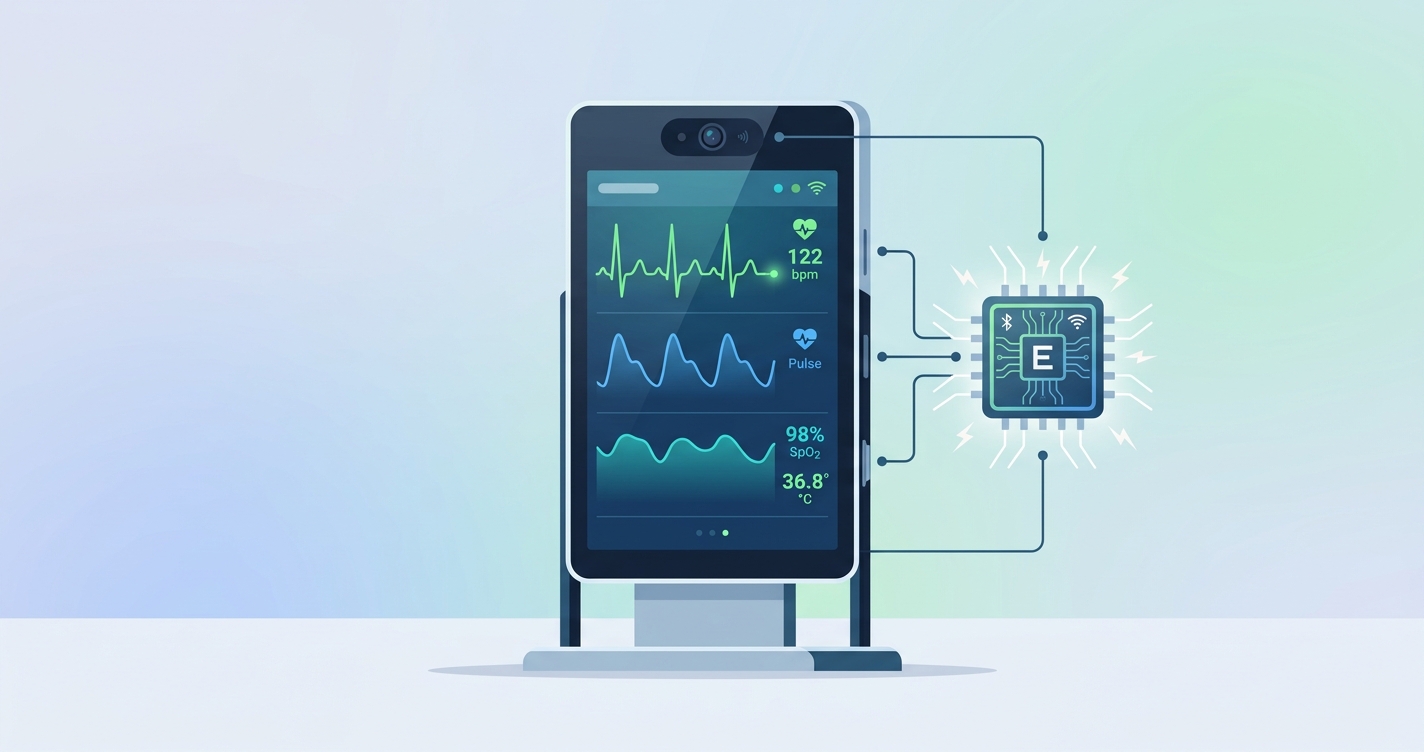
Edge computing real time vitals hardware is no longer a niche design problem for a few experimental kiosks. It has become a practical systems question for medical device companies, kiosk manufacturers, and embedded platform teams that need camera-based vital sign capture to run with low latency, predictable thermals, and minimal network dependence. In this market, the hard part is not proving that remote photoplethysmography can work. The hard part is choosing hardware that can keep working all day in a clinical or public-facing enclosure.
"Simulations demonstrate a 70% latency reduction compared to cloud-only models." — A hybrid fog-edge computing architecture for real-time health monitoring in IoMT systems with optimized latency and threat resilience, 2025
Technical Analysis: Edge Computing Real Time Vitals Hardware
Remote photoplethysmography, or rPPG, relies on subtle color changes in facial skin captured by an RGB camera. Rouast et al. in Artificial Intelligence in Medicine (2018) described camera quality, frame rate, lighting, and motion control as core variables behind usable signal quality. That sounds obvious, but it has direct hardware consequences: if the processor is strong but the camera pipeline is unstable, the system fails; if the camera is good but the thermal design forces throttling, the system still fails.
For embedded deployments, the hardware stack usually breaks into six layers: camera, image signal path, compute, memory/storage, networking, and enclosure power/thermal design. Real-time vital sign screening only works when those layers are sized together rather than selected one at a time.
Baseline hardware thresholds
Research on measurement conditions gives a useful floor. Kobayashi et al. in Sensors (2021) reported that rPPG heart rate variability measurements were most reliable above 500 lux with front lighting, and that frame rates above 30 fps were needed for sufficiently accurate R-R interval and HRV capture. That finding matters because it turns vague camera guidance into hardware specifications: a kiosk intended for real-time vitals should be designed around stable illumination and sustained 30 fps capture, not best-case lab conditions.
| Hardware layer | Minimum practical requirement | Why it matters for real-time vitals |
|---|---|---|
| RGB camera | 1080p sensor, stable 30 fps | Below this, signal resolution and temporal fidelity fall off quickly |
| Illumination | Controlled front lighting, ideally 500+ lux at face position | rPPG quality depends on stable, sufficient light |
| Processor | Multi-core ARM or x86 edge platform with GPU/NPU assist when available | Face tracking, ROI extraction, filtering, and estimation must run without queue buildup |
| Memory | 4-8 GB RAM for kiosk-class systems | Needed for video buffers, UI, analytics, and concurrent services |
| Storage | SSD or eMMC with local logging | Supports offline operation, diagnostics, and software rollback |
| Networking | Ethernet or managed Wi-Fi, but not cloud-dependent for inference | Vital sign estimation should continue during WAN interruption |
| Thermal design | Passive-plus-active cooling for 12+ hour duty cycles | Prevents clock throttling and unstable latency |
Processor selection: enough headroom, not just enough to boot
The most common design mistake is sizing the processor to the average pipeline instead of the worst case. Real-time vital sign systems do not process a clean, static face in a vacuum. They handle face reacquisition, autofocus shifts, variable skin tones, screen rendering, encrypted local storage, and fleet telemetry at the same time.
A useful reference point comes from the 2022 benchmarking study on ARM-based embedded platforms for contactless heart rate measurement. That work reported about 96.7% average accuracy across platforms and found the Odroid N2+ especially favorable on CPU load, RAM use, and execution time. The larger lesson is broader than any single board choice: embedded rPPG can run well on ARM hardware, but platform efficiency depends heavily on memory bandwidth, camera I/O, and how much of the vision stack is offloaded.
For teams building kiosk hardware in 2026, processor classes usually break down like this:
| Platform class | Typical fit | Strengths | Constraints |
|---|---|---|---|
| Cortex-A53/A55 class boards | Entry prototypes, low-cost endpoints | Low cost, low power | Tight margin for concurrent UI plus vision workloads |
| Cortex-A72/A76 or similar | Most single-user kiosks | Better sustained CPU performance and memory bandwidth | Still sensitive to poor cooling |
| Edge GPU/NPU platforms | High-throughput kiosks, multi-model pipelines | Better face detection and ML inference latency | Higher BOM and thermal requirements |
| x86 edge PCs | Clinical stations with richer local software stacks | Strong compatibility and headroom | More power draw, larger enclosures |
If the device must estimate vitals, render guidance, store audit logs, and integrate with local clinical workflows simultaneously, the safer engineering choice is usually one tier above the bare minimum.
Latency, throughput, and power budgets
Edge hardware choices are often justified on privacy grounds, but latency is the more immediate engineering reason. The 2025 hybrid fog-edge architecture study reported 70% lower latency, 60% bandwidth savings, and 30% better energy efficiency than cloud-only models. In a kiosk environment, those gains show up as shorter sessions, fewer stalled measurements, and less dependence on backhaul quality.
The hardware implication is straightforward: the more of the signal chain that stays on-device, the more deterministic the user experience becomes. That does not mean every analytic function belongs at the edge. It means frame acquisition, face tracking, signal extraction, and first-pass vital sign estimation probably do.
RhythmEdge, presented by Zahid Hasan, Emon Dey, and colleagues in 2024, offers another practical benchmark. Their edge heart-rate system ran on platforms including Jetson Nano, Google Coral, and Raspberry Pi, with reported runtime of 0.64 seconds per 30 frames, minimal latency of 0.0625 seconds, and maximum power consumption of 8 W. Those are not universal numbers, but they are helpful for hardware planning because they show that contactless inference can fit within modest edge power envelopes.
- For wall-powered kiosks, sub-10 W inference hardware is usually acceptable if thermals are managed.
- For tablets or portable screening stations, the same workload may force aggressive duty cycling.
- For multi-user or ambient screening scenarios, the compute budget rises quickly because face tracking scales with subject count.
Deployment Patterns and Tradeoffs
Different deployment environments produce different hardware priorities. That part gets lost in generic "edge AI" discussions.
Waiting room and reception kiosks
These systems live in controlled lighting, run all day, and need predictable thermals more than extreme mobility. Ethernet, active cooling, and SSD-backed local logs make sense here. A platform similar to those discussed in What Is a Health Screening Station? Waiting Room Deployments is usually the cleanest fit.
Pharmacy and retail screening stations
Retail environments care about short sessions, simple maintenance, and graceful recovery after user misalignment. In these systems, camera framing and lighting consistency matter almost as much as processor choice. Our earlier analysis of How Pharmacy Kiosks Use Contactless Health Screening points in the same direction: stable throughput usually beats peak benchmark performance.
Rugged or field-deployed devices
These systems are harder. Power availability is less predictable, temperature swings are wider, and network connectivity cannot be assumed. Hardware needs shift toward lower wattage processors, wider operating temperature ranges, and store-and-forward architecture for results.
Current Research and Evidence
The current evidence base points to a fairly consistent hardware story.
Rouast et al. (2018) reviewed remote photoplethysmography as a camera-based measurement method whose performance changes materially with hardware and environment, especially illumination and motion. Kobayashi et al. (2021) found that front lighting above 500 lux and frame rates above 30 fps materially improved HRV measurement conditions. De Haan and Jeanne's CHROM method in IEEE Transactions on Biomedical Engineering (2013) remains important because it showed how algorithm design can reduce specular reflection artifacts, making commodity RGB cameras more viable.
Recent embedded work fills in the deployment side. The 2022 ARM-platform benchmarking study showed that low-cost embedded hardware can still deliver about 96.7% average heart-rate accuracy when the pipeline is designed carefully. Hasan, Dey, and colleagues demonstrated in RhythmEdge (2024) that contactless heart-rate estimation can run on resource-constrained edge hardware with modest latency and power use. And the 2025 hybrid fog-edge health-monitoring architecture adds the network perspective, showing measurable gains in latency, bandwidth, and energy use when time-sensitive processing stays near the sensor.
| Study | Year | Useful hardware takeaway |
|---|---|---|
| Rouast et al., Artificial Intelligence in Medicine | 2018 | Camera quality, lighting, and motion control are first-order system variables |
| de Haan & Jeanne, IEEE TBME | 2013 | Better signal processing can make standard RGB cameras more practical |
| Kobayashi et al., Sensors | 2021 | Front lighting above 500 lux and 30+ fps improve measurement conditions |
| ARM embedded benchmark study | 2022 | Efficient embedded boards can achieve about 96.7% average accuracy |
| Hasan, Dey et al., RhythmEdge | 2024 | Edge inference can fit within low-latency, sub-10 W operating envelopes |
| Hybrid fog-edge IoMT architecture | 2025 | Edge-first design can cut latency by 70% and bandwidth by 60% |
The Future of Edge Vitals Hardware
The next phase of edge vitals hardware will probably look less like a general-purpose mini PC and more like an integrated vision appliance. That means tighter coupling between camera ISP, NPU, and local storage; lower idle power; and better fleet manageability from the start.
I also expect the hardware conversation to get more practical. Buyers do not just want to know whether rPPG runs on a dev board. They want to know whether the device can stay accurate enough, cool enough, and maintainable enough after months in a clinic lobby. That is a much more interesting question, and honestly, a more useful one.
FAQ
What camera specs are needed for real-time contactless vitals at the edge?
A practical baseline is a 1080p RGB camera with stable 30 fps capture, paired with controlled front lighting. Research by Kobayashi et al. suggests that frame rates above 30 fps and lighting above 500 lux improve measurement quality for HRV-related use cases.
Can Raspberry Pi-class hardware run real-time vitals workloads?
Yes, for some workloads. Recent edge research and benchmarking show that low-cost ARM systems can support contactless heart-rate pipelines, especially when the software stack is optimized. The limitation is not whether they run at all, but how much headroom remains once the system also handles UI, logging, encryption, and recovery from user motion.
Why is thermal design so important in edge vitals kiosks?
Because a kiosk may run continuously for 12 hours or more. If the enclosure traps heat, the processor can throttle, which increases latency and destabilizes frame processing. In practice, thermal failure looks like inconsistent user sessions long before it looks like a full system crash.
Should real-time vitals be processed fully on-device or partly in the cloud?
The time-sensitive parts should usually stay on-device: video capture, face tracking, signal extraction, and first-pass estimation. Cloud systems still make sense for fleet analytics, reporting, and non-urgent review, but real-time inference benefits from edge execution because it reduces latency and bandwidth dependence.
Choosing hardware for edge-based vital sign capture is really an exercise in systems discipline. The strongest designs balance camera stability, compute headroom, thermal control, and offline resilience instead of chasing a single benchmark. For teams building embedded screening stations or clinical kiosk platforms, solutions like Circadify's custom clinical kiosk builds are aimed at that integration problem.