Where rPPG Fits in the Connected Health Device Ecosystem
Analysis of the rPPG connected health device ecosystem, including how camera-based vitals fit across kiosks, edge devices, RPM platforms, and interoperable care workflows.
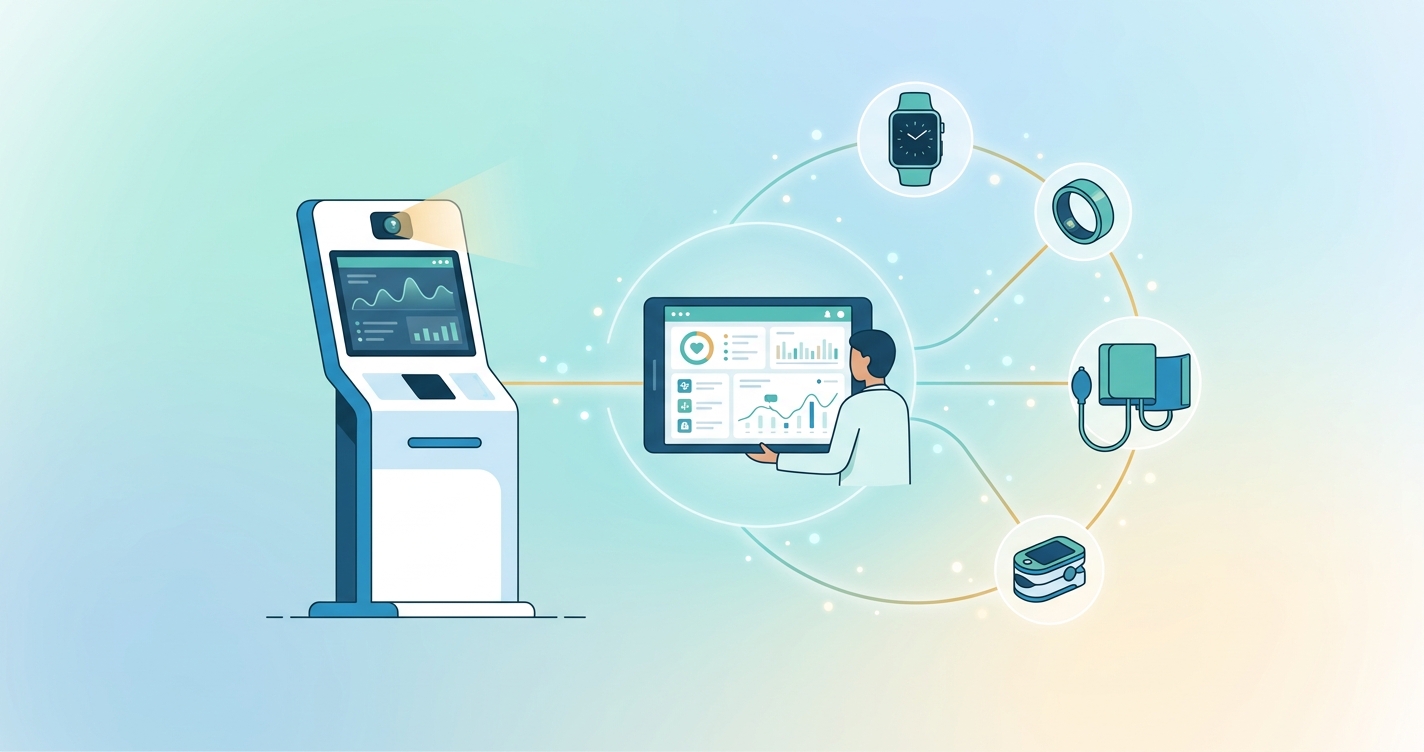
The rPPG connected health device ecosystem is getting easier to describe in business decks and harder to define in engineering terms. Camera-based vital sign sensing does not sit in just one market category. It touches clinical kiosks, tablets, smart displays, remote patient monitoring workflows, and the broader Internet of Medical Things. For device manufacturers, the real question is not whether rPPG belongs in connected care. It is which layer of the stack it actually strengthens, and where it still depends on the rest of the system around it.
"The use of video cameras for contactless monitoring of vital signs can make healthcare more flexible and more accessible." — Robert van Geest, Jeroen van der Laar, and Ronald Janssen, Sensors, 2023
rPPG connected health device ecosystem: the architecture view
Remote photoplethysmography measures subtle skin-color changes caused by blood flow using a standard camera. Verkruysse, Svaasand, and Nelson showed the underlying concept in Optics Express in 2008 with ambient-light plethysmographic imaging. Two years later, Ming-Zher Poh, Daniel McDuff, and Rosalind Picard published a widely cited 2010 Optics Express paper showing non-contact pulse measurement from facial video using blind source separation.
That scientific foundation matters, but it only explains the sensing layer. In connected health, rPPG usually lives inside a larger device and software chain:
- a camera and illumination environment capture facial video
- an edge processor handles face tracking and signal extraction
- local software estimates heart rate, respiratory rate, and related metrics
- an application layer presents results to staff, patients, or operators
- an integration layer sends outputs into RPM, EHR, kiosk, or analytics systems
That is why rPPG is best understood as an enabling modality rather than a standalone category. It can be the sensing engine inside a connected device, but it still depends on enclosure design, compute choices, workflow integration, and interoperability rules.
| Ecosystem layer | What rPPG contributes | What the rest of the system still must provide |
|---|---|---|
| Sensor layer | Contactless capture of pulse-related optical signals | Camera quality, lighting control, positioning |
| Edge device layer | Local extraction of vital-sign signals from video | CPU/GPU/NPU resources, thermal stability, memory |
| Application layer | Fast user-facing measurement experience | UX, identity handling, session timing, error states |
| Clinical workflow layer | Structured vital data for screening and follow-up | Triage logic, staffing rules, escalation paths |
| Enterprise integration layer | Data that can feed RPM or health IT platforms | APIs, FHIR or HL7 mapping, audit trails, security |
Why rPPG fits best in semi-structured connected environments
One thing becomes obvious when you read the literature closely: rPPG tends to perform best when the environment is somewhat controlled. That is not a weakness unique to camera-based sensing. It is just the difference between a lab idea and a deployable product.
The 2023 review by van Geest and colleagues described rPPG as promising for healthcare, but also clear about the operational variables that shape results: lighting, motion, camera specifications, and signal-processing choices. Those are manageable variables in kiosks, tablets on stands, check-in stations, and supervised RPM workflows. They are harder variables in fully unconstrained consumer environments.
That helps explain where rPPG sits most naturally inside connected care today.
Clinical kiosks and self-service screening stations
This is probably the cleanest fit. Kiosks offer fixed camera placement, predictable distance, stable lighting, and a short guided interaction. Saksham Bhutani, Aymen Alian, Richard Ribon Fletcher, Hagen Bomberg, Urs Eichenberger, Carlo Menon, and Mohamed Elgendi reported in their 2025 Communications Medicine systematic review that health kiosks are being explored for chronic and infectious disease screening, with blood pressure as the most frequently measured vital sign and cardiovascular detection driving 56% of the reviewed projects.
In other words, kiosks already solve some of the environment problems that connected sensors hate.
Embedded medical devices and smart displays
In this layer, rPPG functions less like an app feature and more like a subsystem. Device makers care about frame timing, ISP behavior, compute headroom, thermal design, and whether inference runs locally or in the cloud. That is the same logic behind posts like Embedded Vitals: Power, Bandwidth, and Hardware Requirements and rPPG for IoT: Integration Architecture and Requirements.
Remote patient monitoring endpoints
rPPG also fits into RPM, though usually as one intake option among several. It works well for low-friction spot checks, onboarding, triage, or repeated short assessments when wearable adherence is weak. It is less useful if a program expects uninterrupted continuous sensing under all household conditions.
How rPPG compares with other connected health device roles
The connected health device ecosystem includes wearables, cuffs, oximeters, kiosk peripherals, cameras, gateways, and care-management software. rPPG does not replace all of that. It changes where data collection can happen and how much hardware the patient or operator has to manage.
| Device approach | Strength in connected health | Limits in deployment planning | Best role for rPPG relative to it |
|---|---|---|---|
| Wearables | Continuous longitudinal data | Charging, adherence, device fatigue | Complement for low-friction spot checks and onboarding |
| Contact peripherals | Familiar clinical workflows | Consumables, cleaning, physical contact | Alternative in self-service or high-throughput environments |
| Kiosk-based sensors | Guided measurement and fixed setup | Requires site installation and maintenance | Strong fit as the camera-based sensing layer |
| Smartphone apps | Wide hardware availability | Camera variability and uncontrolled environment | Useful when workflow can guide the user tightly |
| Smart displays and tablets | Good balance of user guidance and deployment flexibility | Shared compute and thermal constraints | Strong fit for embedded edge inference |
A connected health system gets more value from rPPG when it uses the modality where it reduces friction. That usually means removing physical attachments, simplifying cleaning, speeding up triage, or extending vital checks into places where traditional devices are awkward.
Industry applications across the connected care stack
Waiting-room and ambulatory intake
Hospitals and clinics keep looking for ways to move routine intake upstream. A guided camera-based screen can gather baseline data before the staff encounter starts. That makes rPPG relevant not because it is novel, but because it can fit existing check-in flows.
Pharmacy and retail health deployments
Retail settings value short interaction times and easy reset between users. Contactless capture can reduce moving parts and lower maintenance complexity compared with stations built around multiple physical accessories.
RPM and chronic care programs
Care teams managing hypertension, COPD, or heart failure do not just need measurements. They need repeatable patient participation. In that setting, a quick camera-based session may be more realistic than asking every patient to wear, charge, and sync another device.
Enterprise device platforms
For OEMs and platform teams, rPPG can be another edge workload running alongside identity checks, telehealth intake, wellness screening, or fraud detection. That is one reason the technology shows up in both medical-device conversations and broader connected-device roadmaps.
Current research and evidence
The research base is broad enough now to show where rPPG belongs, even if it does not answer every deployment question.
Verkruysse, Svaasand, and Nelson's 2008 paper established that ambient light can support remote plethysmographic imaging. Poh, McDuff, and Picard's 2010 study pushed the field forward by showing automated pulse measurement from facial video. Those early papers still matter because most connected-health implementations are building on that same camera-plus-signal-processing logic.
Van Geest, van der Laar, and Janssen's 2023 review in Sensors positioned rPPG more directly for healthcare use. Their review focused on where contactless monitoring makes operational sense and where practical issues still shape deployment, especially camera setup and measurement conditions.
Bhutani and colleagues' 2025 kiosk review adds an important ecosystem point: connected screening hardware has moved beyond concept demos, but performance testing, user-experience evaluation, and standardization still need work. That feels like the right level of caution. The market is not waiting for perfect consensus, but buyers do want repeatable systems.
Outside the academic literature, connected-device market reports point to the same macro trend. The connected medical device and RPM markets are both expanding quickly, driven by chronic disease management, telehealth workflows, and demand for home-based care. That growth does not guarantee rPPG adoption, but it does create more places where low-friction sensing can earn a role.
The future of rPPG in connected health
The most likely future for rPPG is not as a single-purpose gadget. It is as a native feature inside devices that already belong in care workflows.
A few shifts seem especially likely:
- more edge inference, so raw video stays local and latency stays low
- more multimodal devices that combine camera-based sensing with questionnaires, thermal inputs, or connected peripherals
- more standards work around data packaging and workflow integration
- more buyer scrutiny around lighting envelopes, camera specs, and repeatability outside the lab
I think that last point matters more than people admit. rPPG is leaving the stage where a clever demo is enough. In the connected health device ecosystem, the winning products will be the ones that behave like dependable systems, not just impressive sensing engines.
Frequently asked questions
Is rPPG a medical device category on its own?
Usually no. In practice, rPPG is more often the sensing method inside a broader connected device, application, or workflow. It is one layer of the system rather than the whole system.
Where does rPPG fit best in connected health today?
It fits best in semi-structured environments such as kiosks, guided tablet workflows, check-in stations, and selected RPM use cases where lighting, positioning, and session timing can be managed.
Does rPPG replace wearables in connected care?
Not entirely. Wearables remain better for continuous longitudinal monitoring. rPPG is strongest where a program wants fast, low-friction spot checks without attaching hardware to the user.
Why do device manufacturers care about interoperability if the sensing happens on the edge?
Because the measurement is only useful when the output can move into the rest of the care system. Device teams still need APIs, audit logs, secure transport, and structured data mappings to make rPPG useful at scale.
For medical device companies and kiosk manufacturers, the commercial opportunity is not just adding camera-based vitals. It is placing that capability in the right part of the workflow, with the right hardware envelope and integration path. That is the gap solutions like Circadify's clinical kiosk integration work are built to address.