How Senior Living Facilities Use Embedded Health Screening Kiosks
Research-based analysis of how senior living embedded health screening kiosk systems support intake, routine monitoring, staffing workflows, and safer resident oversight.
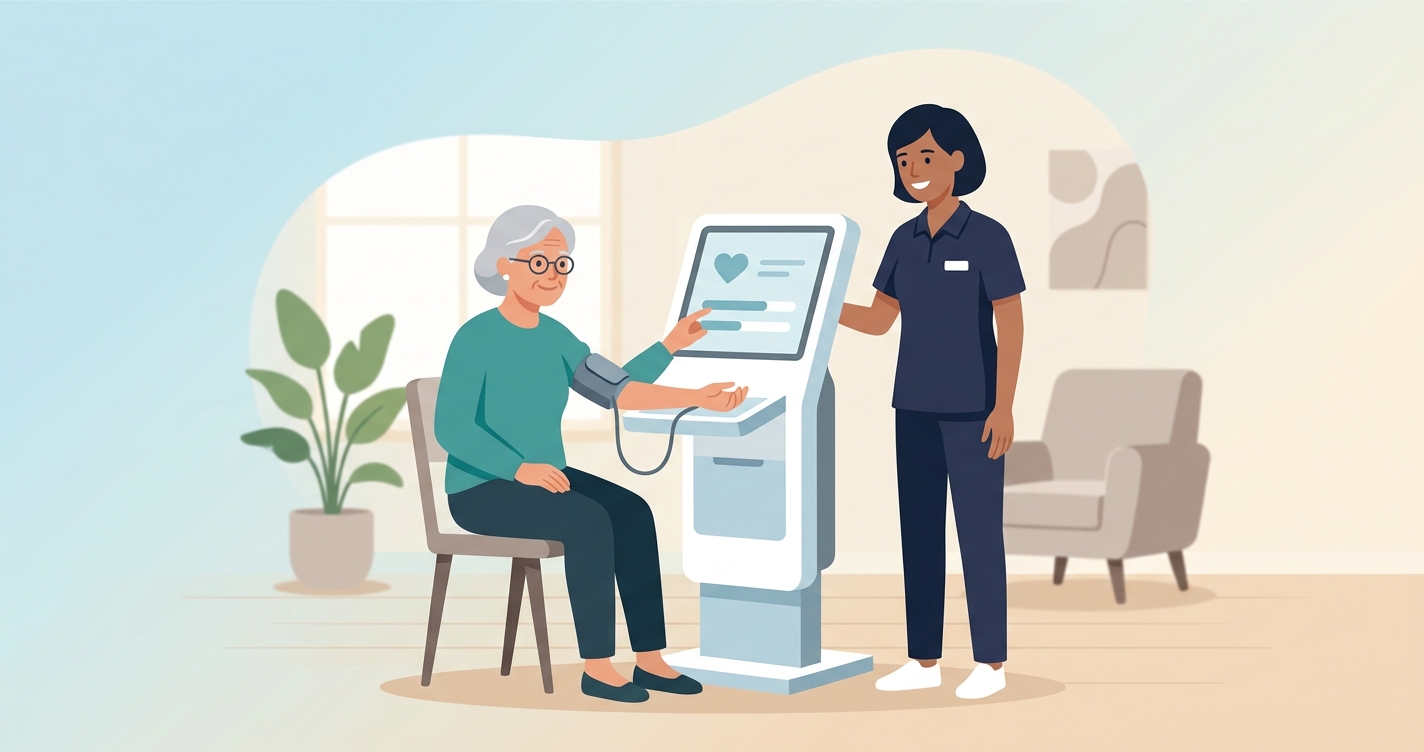
The senior living embedded health screening kiosk market is getting attention for a simple reason: resident needs are rising faster than staffing capacity. Operators are caring for older adults with higher acuity, more chronic conditions, and more frequent monitoring needs, but they still need workflows that feel calm and low-friction for residents. That is where embedded kiosks fit. They are less about replacing clinicians and more about creating a reliable station for quick check-ins, repeatable screening, and cleaner handoffs to nurses, wellness teams, and remote care partners.
"Automated health alerts are sent to staff based on algorithms applied to sensor data, often days or weeks before typical symptoms are detected by individuals or family members." — Marilyn J. Rantz and colleagues, University of Missouri, 2017
Why a senior living embedded health screening kiosk fits the current care model
Senior living operators are dealing with a real mismatch between demand and labor. A 2025 NIC workforce analysis projected that the United States will need about 660,000 more workers in core care roles by 2033 to meet demand in senior housing and skilled nursing. Separate industry survey coverage in 2025 also found that 74% of clinical leaders reported rising resident acuity in the prior year, while 63% said acuity is underreported.
That context matters because kiosks are usually adopted when routine work starts to crowd out higher-value clinical time. In senior living, the repeating tasks are familiar:
- intake or move-in screenings
- wellness checks during routine visits
- blood pressure, pulse, or oxygen spot checks
- symptom questionnaires before group activities or appointments
- escalation to telehealth or nurse review when something looks off
An embedded kiosk gives those tasks a fixed place in the workflow. Residents know where to go. Staff know what data gets captured. Device makers know the operating environment is more predictable than a fully mobile setup.
| Deployment model | Best fit in senior living | Main advantage | Main constraint |
|---|---|---|---|
| Lobby or front-desk kiosk | Visitor, vendor, and resident intake | Easy supervision and high visibility | Can create queues at peak times |
| Wellness room station | Scheduled resident screenings | Better lighting and guided positioning | Requires room allocation |
| Memory care unit kiosk bay | Supervised repeat checks | Controlled environment and staff support | Needs simplified UX |
| Dining or activity-adjacent station | Routine low-friction check-ins | Builds screening into daily flow | Noise and motion can reduce signal quality |
| Telehealth pod with embedded vitals | Virtual consult support | Clean handoff from screening to clinician | Higher hardware and integration cost |
What senior living operators actually want from kiosk-based screening
The interesting thing here is that operators rarely want a flashy kiosk. They want a boring one. Reliable camera framing, clear prompts, short capture windows, and data that can move into the right dashboard matter more than novelty.
The AHRQ-funded project led by Judith Matthews, PhD, MPH, RN, makes that pretty clear. Her study on self-management via health kiosks deployed multi-user kiosks across 13 community venues serving older adults, including senior centers, senior housing, and libraries. The point was not just to test interest in the hardware. It was to understand motivations, design preferences, and the factors that drive sustained use.
That is still the right design question for senior living facilities. If a kiosk is going to work, it has to respect the realities of older users:
- variable comfort with touchscreens
- hearing and vision limitations
- wheelchair access needs
- privacy expectations in shared environments
- anxiety around anything that feels like a test
A kiosk that looks technically impressive but confuses residents will simply move work back to staff.
Where embedded vitals matter most inside senior living communities
Not every screening event needs the same architecture. That is why senior living deployments usually work better when the kiosk is matched to a narrow operational purpose.
Move-in and baseline assessments
Communities often need a structured first-pass screening when a new resident arrives or changes level of care. A kiosk can standardize questionnaires, basic readings, and identity-linked records before a nurse follows up.
Routine wellness checks
This is probably the most practical use case. Residents with hypertension, COPD, heart failure, or recovery needs often benefit from repeat measurements, but constant staff-led spot checks do not scale well.
Telehealth support stations
When the kiosk sits inside a telehealth room or care pod, it becomes a workflow bridge. Staff can guide the resident through capture, then pass the result into the virtual visit.
Early-change detection
Rantz and colleagues argued for a broader set of technology-enabled vital signs in older adults, including respiration, pulse, restlessness, gait speed, and activity patterns. That matters because senior living teams often care less about a single number and more about whether a resident is drifting from baseline.
| Use case | What the kiosk captures | Why the community cares |
|---|---|---|
| Move-in screening | Demographics, symptom intake, spot vitals | Establishes baseline and triage path |
| Routine wellness check | Repeat vitals and short questionnaires | Supports chronic disease oversight |
| Telehealth handoff | Guided pre-visit measurements | Makes virtual consults more actionable |
| Staff escalation | Repeat check after symptom report | Helps decide whether nurse review is needed |
| Program analytics | Aggregate trends by unit or cohort | Supports population-level staffing and planning |
Design requirements for senior-friendly kiosk deployments
There is good evidence that acceptance depends heavily on ease of use. Wonjae Jang and colleagues studied healthcare kiosk acceptance among older adults in South Korea and found that perceived quality, ease of use, and usefulness all shaped adoption intent. That sounds obvious, but it has real product implications.
A senior living kiosk needs:
- large on-screen text and high contrast
- simple prompts with minimal branching
- calm audio guidance when needed
- seated and wheelchair-friendly camera framing
- stable illumination and predictable distance from face to camera
- fast retry logic that does not make the user feel blamed
I keep coming back to that last point. Older adults will tolerate a short delay. What they usually will not tolerate is a machine that feels fussy or judgmental.
This is also where embedded systems matter more than generic tablets on a stand. Fixed hardware placement, known lighting, thermal management, and local processing all improve consistency. In senior living, consistency often decides whether staff trust the tool enough to keep using it.
Current research and evidence
The evidence base around kiosk use in older populations is less about hype than about fit.
Marilyn J. Rantz and colleagues at the University of Missouri described environmentally embedded sensing as a way to identify health changes in older adults days or weeks earlier than family members or staff might otherwise notice. Their 2017 work focused on function-oriented signals such as pulse, respiration, restlessness, gait speed, and fall detection. That does not mean every senior living community needs ambient sensing everywhere, but it does support the idea that embedded monitoring belongs in elder-care workflows.
Judith Matthews' AHRQ-funded kiosk study looked at how community-residing older adults interacted with multi-user kiosks in 13 sites. The project emphasized self-management modules, questionnaire intake, and physical measures rather than passive monitoring alone. That is useful for senior living developers because it shows kiosk adoption improves when the station is tied to understandable resident goals.
Wonjae Jang and co-authors found that older adults' intention to use healthcare kiosks rises when systems feel useful and easy to use. For senior living buyers, that makes accessibility a procurement issue, not just a design preference.
There is also broader support for noncontact measurement. In a 2024 narrative review in Medical Science Monitor, Yoo Jin Choo, Gun Woo Lee, Jun Sung Moon, and Min Cheol Chang concluded that noncontact sensors for vital signs show performance that can be comparable to traditional measurement methods in appropriate settings, while also improving comfort and reducing skin-related concerns. In a senior living setting, where repeated contact measurements can feel intrusive, that comfort piece matters.
For additional context, see What Is an Ambient Health Sensor? Embedded Vitals for Smart Spaces and What Is Continuous Ambient Monitoring? Embedded Vitals Beyond the Kiosk.
The future of senior living kiosk deployments
The next wave of senior living kiosk adoption will probably be less about putting a machine in the lobby and more about placing the right station in the right workflow. Wellness rooms, telehealth suites, rehab corners, and memory-care support areas all have different needs.
I also expect communities to ask harder questions about architecture. Should the kiosk process camera-derived signals locally? How much raw data needs to be stored? Can the station keep working if connectivity drops? Those are embedded-systems questions, not marketing questions.
Longer term, the line between kiosk and ambient endpoint may blur. A community may use a guided kiosk for structured screenings and a separate embedded sensor layer for passive baseline tracking in selected rooms or common spaces. That hybrid model makes more sense than pretending one device solves every monitoring problem.
Frequently Asked Questions
Do senior living health screening kiosks replace nurses or caregivers?
No. In most communities, the kiosk handles standardized intake, repeat measurements, or first-pass screening. Nurses and caregivers still interpret context, assess symptoms, and decide what happens next.
Which residents benefit most from an embedded health screening kiosk?
The clearest fit is residents who need recurring spot checks, telehealth prep, wellness program oversight, or structured move-in screening. The kiosk is most useful when repeatable workflows matter.
Why is an embedded kiosk better than a mobile tablet cart?
A fixed kiosk usually offers better camera alignment, steadier lighting, cleaner cable management, and more predictable user positioning. That makes measurements and operations more consistent.
What should device makers prioritize for senior living deployments?
Accessibility first, then reliability. Communities care about large text, audio prompts, wheelchair access, local processing, remote fleet management, and simple escalation paths far more than flashy interface features.
Senior living communities are not looking for science fiction. They are looking for dependable infrastructure that fits daily care. That is why embedded systems matter here. Solutions like Circadify's clinical kiosk integration work are aimed at helping device makers and operators build screening stations that work inside real care environments.