
What Is Continuous Ambient Monitoring? Embedded Vitals Beyond the Kiosk
A research-based look at continuous ambient monitoring embedded vitals devices, including room sensors, edge AI, workflow design, privacy controls, and deployment tradeoffs.
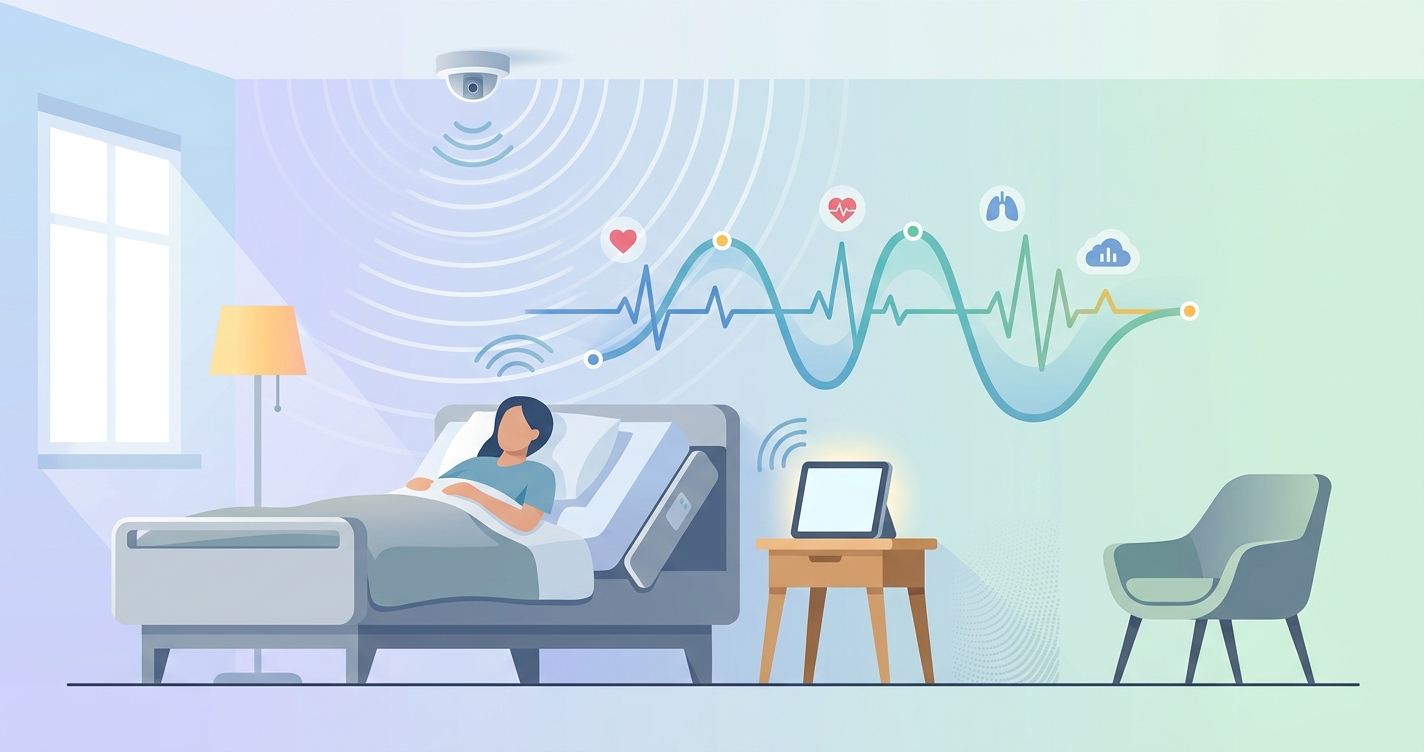
Continuous ambient monitoring embedded vitals devices are getting attention because kiosk workflows solve only part of the monitoring problem. A kiosk works when a person is willing to stop, stand still, and complete a guided capture. Hospitals, senior living operators, and device makers are now asking a different question: what happens after the kiosk moment ends? That is where continuous ambient monitoring enters the picture. Instead of relying on a single check-in station, teams place cameras, radar, thermal sensors, and edge processors into rooms, bedsides, wall units, and smart displays so vital-sign capture can happen more quietly and more often.
"The findings reveal that blood pressure is the most frequently measured vital sign, utilized in 34% of the studies... several research gaps remain, including a lack of performance testing, user experience evaluation, clinical intervention, development standardization, and inadequate sanitization protocols." — Saksham Bhutani, Aymen Alian, Richard Ribon Fletcher, Hagen Bomberg, Urs Eichenberger, Carlo Menon, and Mohamed Elgendi, Communications Medicine, 2025
Continuous ambient monitoring embedded vitals devices: what the term actually covers
Continuous ambient monitoring is not one product category. It is a deployment model. The common thread is that sensing moves off the body and into the environment.
In practice, that can mean:
- a wall-mounted camera endpoint in a triage bay
- radar built into a bedside monitor or smart display
- a waiting-room enclosure that shifts from episodic capture to repeat observation
- a senior living room sensor that watches for changes in breathing or movement patterns
- a clinical device that runs local inference and sends only structured measurements upstream
That last point matters more than the marketing language. Continuous monitoring sounds expansive, but most workable systems are still narrow by design. They are built around a controlled distance, a defined field of view, and a limited list of outputs. The more disciplined the environment, the more believable the monitoring claims.
| Deployment model | Typical sensor stack | Best fit | Main constraint |
|---|---|---|---|
| Kiosk-only capture | RGB camera, guided UI, edge compute | Check-in and single-session screening | No visibility between sessions |
| Semi-ambient clinical bay | Camera, lighting control, optional thermal or radar | Intake, triage, recovery | Enclosure design and workflow fit |
| Bedside or chair-side monitor | Radar, thermal, camera, edge processor | Intermittent observation in care settings | Motion artifacts and alarm logic |
| Smart room endpoint | Camera plus radar with local inference | Senior care, low-acuity rooms, passive observation | Privacy expectations and room variability |
| Embedded display or appliance | Camera, ISP, NPU, optional multimodal sensing | OEM medical devices and smart displays | Compute, thermals, and lifecycle support |
Why the market is moving beyond the kiosk
Kiosks are still useful. They give teams a predictable capture window and a cleaner user experience. But they also depend on a person choosing to engage.
That is the gap continuous ambient monitoring tries to close. If a health system wants more than a single spot check, ambient endpoints can create repeated opportunities to observe heart rate, respiratory rate, activity, and recovery trends without asking staff to attach a sensor every time.
The attraction is operational as much as clinical:
- fewer wearables to charge, clean, replace, and explain
- more chances to collect measurements during routine workflow
- easier integration into rooms, carts, terminals, and fixed equipment
- better fit for populations that do not tolerate contact sensors well
The literature is encouraging, but it is not a blank check. Yoo Jin Choo, Gun Woo Lee, Jun Sung Moon, and Min Cheol Chang wrote in their 2024 narrative review that noncontact vital-sign sensors can address limitations of traditional devices, while still requiring more technical development before wider use. Linas Saikevičius, Vidas Raudonis, Gintaras Dervinis, and Virginijus Baranauskas reached a similar conclusion in their 2024 systematic review: vision-based monitoring is moving quickly, but performance still depends heavily on lighting, motion, and subject variability.
So yes, the market is moving beyond the kiosk. It is just doing so in a fairly cautious way.
The sensing stack behind continuous ambient monitoring
No single sensor handles every room condition well. That is why continuous ambient monitoring embedded vitals devices increasingly rely on layered sensing rather than one camera and a lot of optimism.
Cameras and rPPG
RGB and near-infrared cameras remain central because they are easy to embed and can support remote photoplethysmography, respiration estimation, occupancy detection, and user-positioning logic. They are also the first thing to break when lighting, posture, or line of sight gets messy.
Saikevičius and colleagues noted in Sensors that the field has advanced quickly, especially for pulse and respiratory-rate monitoring, but robust blood-pressure estimation remains less mature. That is a useful reminder for device teams. "Continuous monitoring" should not imply that every vital sign is equally ready for unattended capture.
Radar and motion sensing
Radar adds a different kind of resilience. It can help in low-light settings and is often better suited to respiration and micro-motion detection when visible imaging is limited or undesirable. For bedside and room deployments, radar is attractive because it does not need a bright, flattering capture environment to remain useful.
Thermal and context sensors
Thermal sensors are often less about direct diagnosis and more about context. They can support occupancy awareness, environmental interpretation, and temperature-adjacent workflows. In an ambient system, context is not a side feature. It is what helps the software decide whether a signal is trustworthy enough to use.
Edge AI and local processing
This is the part I would not treat as optional. Continuous ambient monitoring becomes hard to defend if it depends on shipping raw video or continuous room data to the cloud. Edge processing lets teams keep inference local, reduce bandwidth, and emit measurements or events instead of permanent media streams.
| Sensor modality | Strongest current use | Typical weakness | Why teams combine it |
|---|---|---|---|
| RGB / NIR camera | Heart rate, respiration trends, positioning | Lighting changes, motion, occlusion | Cheap, common, easy to embed |
| Radar | Respiration, presence, micro-motion | Multi-person separation, placement tuning | Works without visible-light dependence |
| Thermal | Temperature-related context, occupancy cues | Indirect measurement limits | Adds context and confidence checks |
| Edge processor / NPU | Local filtering, fusion, event output | Thermal and power budgets | Reduces latency and retention risk |
| Multi-sensor fusion | Stability and confidence scoring | Integration complexity | Helps rooms behave more predictably |
Industry applications for ambient vital-sign monitoring
Low-acuity hospital rooms and step-down settings
These settings are often the clearest fit because there is already a managed environment and an existing monitoring workflow. Ambient endpoints can support periodic observation without making every interaction depend on a cuff, clip, or wearable.
Senior living and aging-in-place programs
This use case keeps resurfacing because adherence is the real problem. Andrew Chan and co-authors reported in a 2024 JMIR Aging systematic review that acceptability was moderately positive for in-home localization technologies, particularly with ambient sensors, even though clinical utility remained mixed. That feels like an honest summary of the category: people may accept passive monitoring more easily than they accept yet another device, but operational value still depends on what exactly is being measured.
OEM medical devices and smart displays
For device manufacturers, continuous monitoring is often less about the room and more about the enclosure. A smart display, tablet dock, or bedside terminal can move beyond one-time screening if the optics, processor, and workflow are engineered for repeat capture.
Intake zones and waiting areas
Some teams are not abandoning the kiosk at all. They are widening it. A screening station can evolve into a semi-ambient intake bay that supports repeat checks before, during, or after the main encounter.
Current research and evidence
The evidence base is broad enough to take seriously and narrow enough to demand precision.
Choo, Lee, Moon, and Chang wrote in Medical Science Monitor in 2024 that noncontact sensors can reduce discomfort and support more convenient monitoring, but they also stressed that technical development is still needed. Saikevičius and colleagues reviewed recent non-contact vision-based methods and highlighted the same recurring issues: motion noise, environmental variability, and uneven maturity across metrics.
Bhutani and co-authors provide another useful market signal. Their 2025 systematic review screened 5,537 articles and included 36 studies in the final analysis. They found that blood pressure appeared in 34% of the studies and cardiovascular disease detection was the main motivation in 56%. Just as important, they pointed to weak standardization, missing performance testing, and limited user-experience evaluation. In other words, the field is active, but still messy.
That is exactly why "beyond the kiosk" should not be read as "everywhere, all at once." The more credible path is phased deployment:
- start with a controlled room or enclosure
- focus on one or two realistic signals
- process locally whenever possible
- export structured data instead of raw media
- add ambient coverage only when the workflow proves it deserves it
The future of continuous ambient monitoring
The next wave of embedded vitals devices will probably look less like magical smart rooms and more like disciplined appliances spread across more places. That may sound less exciting, but it is much easier to ship.
I would expect product teams to concentrate on three questions:
- how much of the environment can be controlled
- which signals remain stable enough for repeated capture
- what privacy architecture keeps the system defensible
That privacy piece is not decoration. Continuous monitoring gets easier to justify when raw imagery stays local, retention is short, and the output is a measurement, a trend, or an alert rather than a permanent room recording.
Frequently Asked Questions
What is continuous ambient monitoring in healthcare devices?
It is a model where vital-sign sensing happens through sensors embedded in the environment or device enclosure rather than through a one-time kiosk session or a body-worn monitor.
How is ambient monitoring different from a health kiosk?
A kiosk usually captures data during a guided session. Ambient monitoring aims to support repeated or passive observation before and after that guided moment.
Which vital signs are most realistic for ambient systems today?
Heart rate, respiratory rate, presence, movement-related trends, and some temperature-adjacent context are the most common starting points. Other metrics remain more dependent on environment and system design.
Why is edge processing important for continuous ambient monitoring?
It reduces latency, lowers bandwidth demands, and helps teams keep raw room data local so they can export only the measurements or events they actually need.
For OEMs, kiosk manufacturers, and IoT platform teams, the important question is not whether ambient monitoring sounds impressive. It is whether the sensing stack fits a real enclosure, a real workflow, and a privacy model you can defend. That is the space solutions like Circadify's clinical kiosk integration work are built for. For related context, see What Is an Ambient Health Sensor? Embedded Vitals for Smart Spaces and Where rPPG Fits in the Connected Health Device Ecosystem.