How Retail Clinics Deploy Self-Service Health Checks
A technical analysis of retail clinic self service health check deployment, including kiosk workflows, staffing models, edge hardware, patient throughput, and embedded vitals design choices.
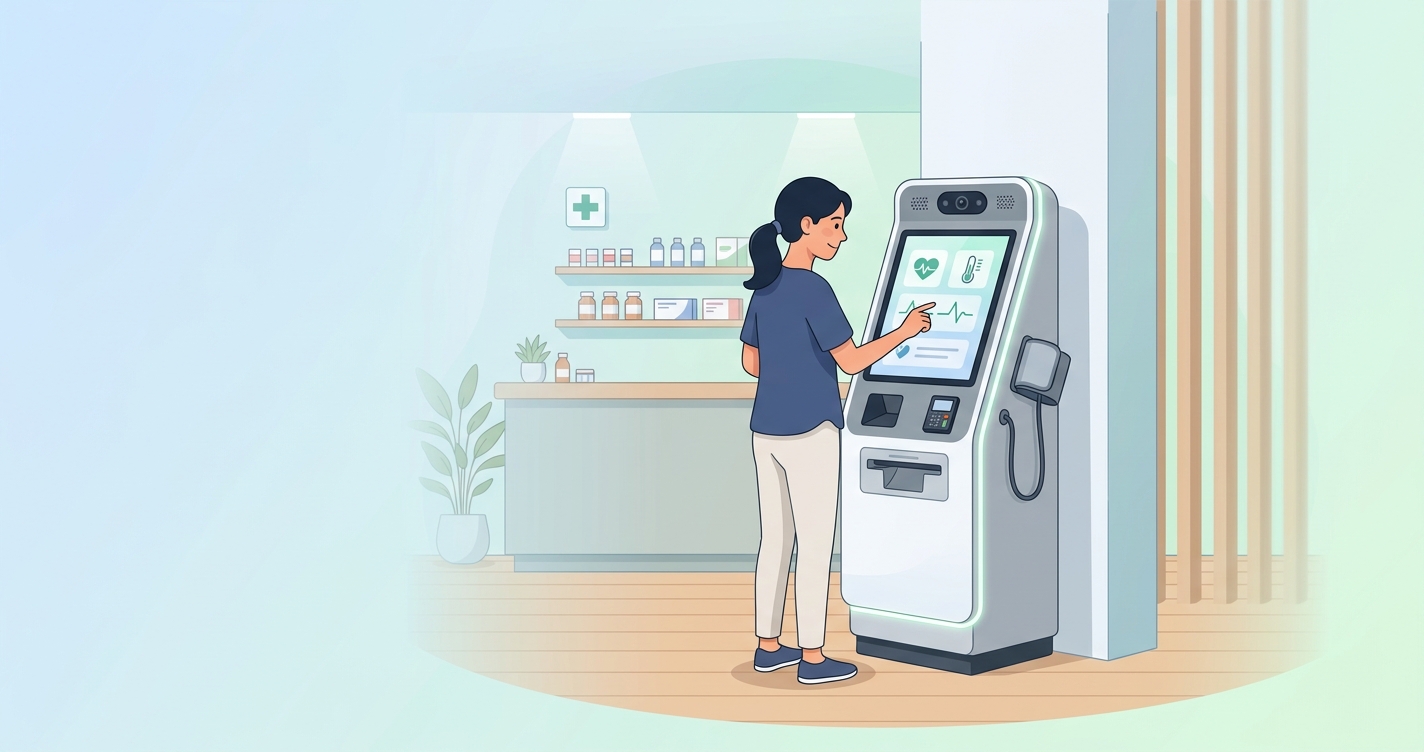
Retail clinic self service health check deployment has stopped being a side experiment and started becoming a workflow problem. Clinics inside pharmacies, big-box stores, and grocers are under pressure to move routine intake faster without turning the visit into a bottleneck. The appeal of self-service is obvious: fewer handoffs, shorter lines, and cleaner data capture. But the deployment question is harder than it looks. A kiosk that checks patients in quickly but fails at identity, vitals capture, or escalation logic just creates a nicer-looking queue.
"Compared to physician offices and urgent care clinics, retail clinics provide less costly treatment for three common illnesses, with no apparent adverse impact on quality of care or delivery of preventive care." — Ateev Mehrotra, Jenny Liu, and colleagues, Annals of Internal Medicine, 2009
Retail clinic self service health check deployment now centers on workflow design
Retail clinics grew because they solved a very practical consumer problem: people wanted care at predictable hours, in familiar locations, without a long appointment cycle. Ateev Mehrotra and colleagues showed back in 2009 that the model could also be cheaper for common acute conditions. Their claims analysis found average episode costs of $110 at retail clinics versus $166 in physician offices, $156 in urgent care, and $570 in emergency departments.
That cost story matters because it explains why operators keep looking for more automation. If the clinic promise is convenience, the front-end workflow has to feel fast. The Convenient Care Association says its member clinics account for roughly 97% of the industry, with more than 3,300 convenient care clinics across North America and more than 50 million patient visits to date. At that scale, shaving even a few minutes from intake starts to look like a serious operations lever.
The catch is that retail clinics are not just retail. They are still care environments. Self-service health checks have to do more than print a queue ticket.
- verify the patient and start the encounter correctly
- collect structured symptoms or visit intent
- support payment, consent, and insurance steps where needed
- capture vitals or readiness signals if the workflow calls for them
- route exceptions to a nurse practitioner, medical assistant, or telehealth clinician
That is why the most successful deployments look less like a generic self-check-in terminal and more like a compact clinical station.
| Deployment model | What the patient does | What staff still handle | Best fit in retail clinics |
|---|---|---|---|
| Basic check-in kiosk | Registration, demographics, consent | Triage, vitals, exam | Low-complexity clinics starting automation |
| Guided health check station | Check-in plus symptom intake and screening questions | Clinical review and exceptions | Vaccination, minor illness, wellness screening |
| Kiosk with embedded vitals | Check-in plus camera or sensor-based vitals capture | Escalation and diagnosis | Higher-volume sites with repeatable protocols |
| Hybrid kiosk + virtual clinician | Intake and guided measurement before telehealth consult | Remote clinician review, in-person fallback | Retail sites expanding beyond staffing limits |
Why staffing pressure keeps pushing clinics toward self-service
I keep coming back to the labor piece because it is usually the real reason these projects get funded. Retail clinics run on tight staffing models. If the nurse practitioner or clinic lead spends too much time on registration cleanup, repetitive intake, or failed handoffs, the throughput math falls apart.
There is research behind that intuition. In Health Affairs, Ateev Mehrotra and Mary Reed wrote in 2013 that retail clinics can increase overall spending partly by drawing in new demand through convenience. That sounds like a criticism, and in one sense it is. But operationally it also means convenience changes volume. Once a clinic becomes easier to use, more people use it. Front-end systems have to be designed for that reality.
Self-service helps when it removes repetitive staff work without dumping confusion back onto the clinical team. In practice, retail operators usually want three things:
- fewer manual registration touches
- predictable visit starts during evening and weekend peaks
- better capture of structured data that can sync into the EHR or queue manager
Those goals are achievable, but only if the hardware and software are sized for real stores rather than lab demos.
What a retail clinic kiosk actually needs to do
A retail clinic sits in an awkward environment for embedded hardware. It is public-facing, noisy, brightly lit in some spots and dim in others, and often squeezed into a footprint that was never designed as a clinic in the first place. That makes retail deployment different from a hospital registration desk.
A useful self-service health check station usually needs these layers:
1. Fast patient identification
The station should start the visit with as little friction as possible: phone number, QR code, ID scan, payer card, or returning-patient lookup. If the first screen already feels slow, patients go straight to the desk.
2. Structured intake
This is where the system earns its keep. A kiosk can standardize symptom intake, reason for visit, travel history, medication prompts, or screening eligibility in ways that are harder to maintain when every staff member asks the questions a little differently.
3. Guided measurement
Not every retail clinic visit needs physiological capture, but some workflows do benefit from guided self-service checks before the clinician steps in. Blood pressure, weight, temperature, and camera-based observation workflows are all easier to scale when the station can guide position, timing, and retry logic.
4. Escalation logic
A self-service health check is only useful if it can stop itself. A patient who reports chest pain, fails identity checks, cannot complete consent, or produces an unusable capture needs an obvious next path.
| Kiosk layer | Retail clinic requirement | Embedded design implication |
|---|---|---|
| Identity | Quick lookup for walk-ins and return visits | Scanner, camera, touchscreen, durable UI flow |
| Intake | Repeatable symptom and consent capture | Local form logic, multilingual prompts, EHR mapping |
| Measurement | Stable guided capture in a public setting | Controlled lighting, camera placement, retry handling |
| Routing | Clear handoff to staff or telehealth | Rules engine, queue integration, visible escalation state |
| Fleet support | Easy support across many store locations | Remote diagnostics, software rollback, device health telemetry |
What the evidence says about self-check-in performance
The literature on self-check-in is not retail-clinic-specific every time, but the operational lessons transfer surprisingly well. A 2020 Southern Medical Journal study, Check-in Kiosks in the Outpatient Clinical Setting: Fad or the Future?, looked at a large academic orthopedic clinic and found that kiosk use reduced check-in duration by 2 minutes and 47 seconds without hurting patient satisfaction. Different setting, yes, but the message is familiar: front-desk time can be compressed if the user flow is clear.
Emergency settings show a similar theme. Natalie Coyle, Andrew Kennedy, Michael Schull, and co-authors reported in the Canadian Journal of Emergency Medicine that self-check-in kiosks supported earlier patient identification and queuing in the emergency department. Retail clinics are less acute, but they share the same operational headache: when the queue forms, the first few minutes of the encounter matter more than anybody wants to admit.
That does not mean every patient loves kiosks. Older adults, first-time visitors, and patients who are anxious or symptomatic often still want a human nearby. The best deployment is usually blended rather than fully unattended.
- visible staff backup matters
- retry flows matter more than fancy UI animations
- clinics need an obvious bypass path for patients who cannot or should not self-serve
Where embedded vitals fit in retail clinics
This is where device teams can overreach. Embedded vitals are attractive because they compress the workflow: a patient checks in, completes intake, and begins guided measurement at the same station. That can be powerful in vaccination screening, minor illness triage, chronic screening campaigns, or employer-sponsored wellness programs hosted in retail spaces.
But signal quality is not automatic. The recent rPPG review by Alora Brown, Joeri Tulkens, Maxime Mattelin, and Brecht Dhuyvetters at IntelliProve makes the point clearly: remote photoplethysmography depends on stable lighting, camera quality, motion control, and well-managed capture conditions. Retail environments make all four harder.
So the smarter deployment pattern is usually controlled self-service rather than passive ambient measurement. The patient stands in a marked zone, receives simple guidance, and the station decides whether the capture is good enough or needs a retry.
For teams already building embedded hardware, that often means borrowing lessons from What Is a Self-Service Health Screening Kiosk? How to Build One and What Is a Health Screening Station? Waiting Room Deployments. Retail clinics need the same basics: predictable camera geometry, edge processing, auditability, and a fallback path when the environment gets messy.
Current research and evidence
The evidence base around retail clinics is stronger on economics and care setting than on kiosk architecture itself, but taken together it points in a pretty consistent direction.
Mehrotra and colleagues in Annals of Internal Medicine showed that retail clinics can treat common acute conditions at lower cost without a measurable drop in quality or preventive care. Mehrotra and Reed in Health Affairs later warned that convenience can also expand utilization, which is a reminder that better access changes demand curves rather than just reallocating visits.
On the self-service side, the outpatient kiosk study in Southern Medical Journal suggests that well-designed check-in systems can cut front-end time meaningfully. The emergency department study by Coyle and colleagues shows that early identification and queuing benefits are real when the kiosk is tied directly to downstream workflow.
And on the embedded-vitals side, the rPPG review from Brown, Tulkens, Mattelin, and Dhuyvetters reinforces a point hardware teams already know in their bones: camera-based health checks work best when the environment is controlled enough to support repeatable capture.
The future of retail clinic self-service health checks
Retail clinics are likely to keep pushing toward mixed-mode encounters. A patient starts with self-service, a clinician reviews the structured intake, and only the exceptions eat real staff time. That is the direction the economics point.
I do not think fully unattended clinical kiosks become the norm in mainstream retail clinics anytime soon. There is too much variability in symptoms, patient comfort, insurance edge cases, and basic human behavior. But I do think clinics will keep moving routine intake, screening eligibility, and selected guided measurements into compact embedded stations.
The winners in this category probably will not be the flashiest devices. They will be the ones that make stores easier to staff, keep the queue moving at 6 p.m., and fail gracefully when a patient needs a person.
FAQ
Why are retail clinics adding self-service health checks?
Mostly to reduce front-desk friction and protect clinician time. Self-service can standardize intake, improve data capture, and shorten the first part of the visit when patient volume spikes.
Do self-service kiosks replace retail clinic staff?
Usually no. They shift repetitive registration and intake work away from staff, but clinics still need clinicians and support staff for exceptions, escalation, and patient reassurance.
Are camera-based vitals practical in retail clinics?
They can be, but only in guided workflows with controlled capture conditions. Public retail environments create lighting and motion problems, so the station needs clear prompts, retry logic, and edge processing.
What matters most in a retail clinic kiosk deployment?
Workflow integration. Hardware, UI, identity, consent, measurement quality, and escalation all need to work together. A fast kiosk that cannot hand off cleanly to staff just moves the bottleneck.
For device makers building retail-clinic hardware, the real opportunity is not a flashy check-in screen. It is a dependable embedded station that can combine intake, guided measurement, queue integration, and remote fleet management in one footprint. Solutions like Circadify's clinical kiosk builds are aimed at that kind of deployment problem.