What Is a Health Screening Station? Waiting Room Deployments
Technical analysis of health screening station waiting room deployment models. Covers workflow design, kiosk architecture, throughput planning, and clinical integration for pre-visit screening stations.
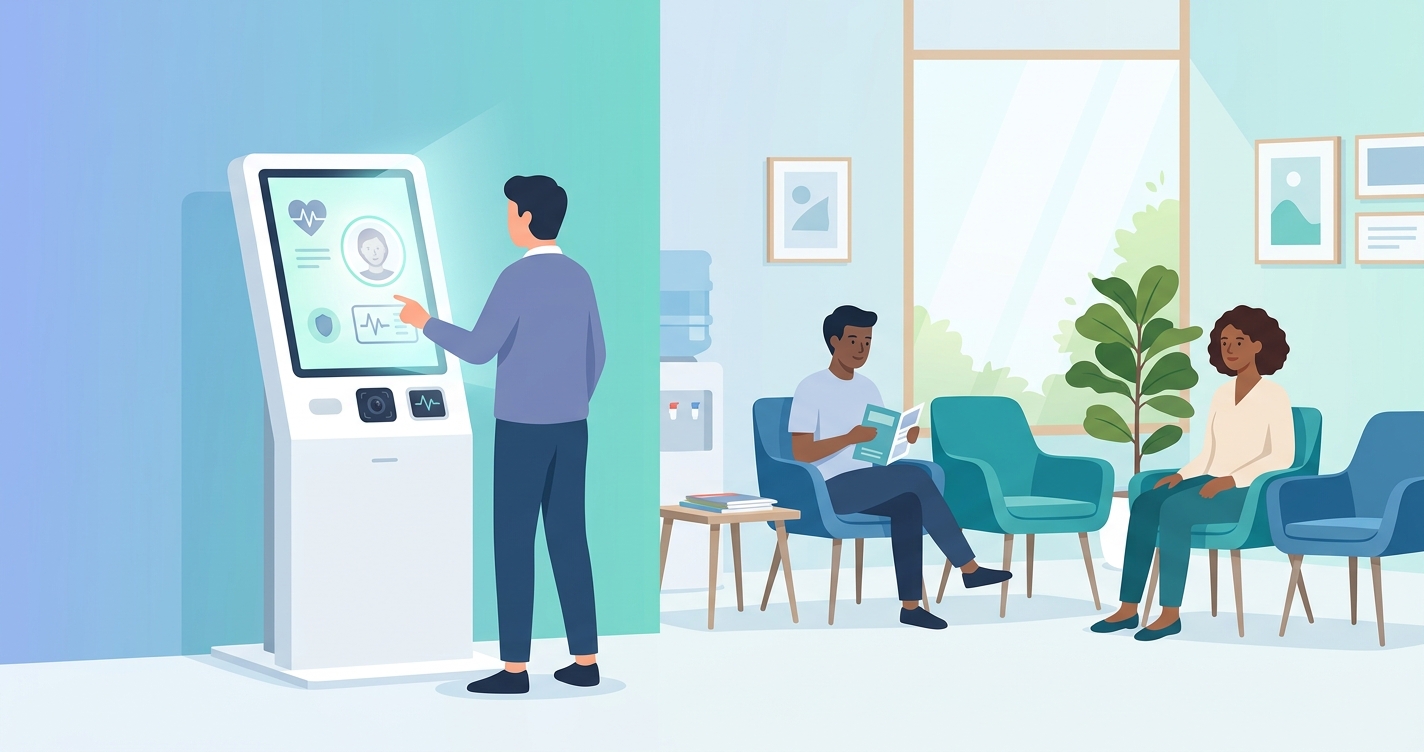
A health screening station is a purpose-built kiosk or embedded device that captures basic physiological data before the clinical encounter begins. In practice, the most important health screening station waiting room deployment question is not whether a clinic can place a device in reception, but whether the station fits patient flow, staff workflow, and the technical constraints of a busy ambulatory setting. For medical device companies and kiosk manufacturers, waiting room deployments are attractive because they convert idle patient time into pre-visit data collection without adding a new room, a new staff role, or a complicated hardware footprint.
"Remote plethysmographic imaging using ambient light" showed that heart and respiration signals could be measured at a distance with an ordinary camera under ambient light conditions. — W. Verkruysse, Lars O. Svaasand, and J. Stuart Nelson, Optics Express, 2008
Health Screening Station Waiting Room Deployment Architecture
A waiting room health screening station sits between check-in and rooming. That sounds simple, but the deployment model is actually a coordination problem: the device has to identify the patient, guide positioning, complete measurement quickly, and move clean data into the clinic workflow before staff call the next patient.
In older deployments, a screening station meant a cuff, a finger clip, a scale, and a thermal printer mounted inside a cabinet. Newer architectures use camera-based measurement, edge compute, and software orchestration to reduce contact surfaces and shorten the session. Gerard de Haan and Vincent Jeanne showed in IEEE Transactions on Biomedical Engineering (2013) that chrominance-based rPPG methods materially improved pulse extraction under motion, which matters in waiting rooms where patients shift, talk, and rarely hold a perfect pose.
The hardware stack for a modern waiting room station usually includes:
- A 1080p RGB camera with fixed focal distance and wide enough field of view for seated and standing users
- Local compute for face detection, signal extraction, and session logic
- A 15" to 22" display with large visual prompts
- Controlled frontal illumination or software exposure compensation for variable lobby lighting
- Network connectivity to pass structured observations into intake or EHR-adjacent systems
- Remote management for uptime, diagnostics, and software updates
The waiting room works well for this model because patients are already stationary for part of the visit. That said, it is less controlled than a dedicated exam bay, so deployment quality comes down to layout discipline.
Waiting Room Deployment Patterns
| Deployment model | Best setting | Measurement window | Main advantage | Main constraint |
|---|---|---|---|---|
| Reception-adjacent station | Primary care, urgent care | 20-45 seconds | Captures data right after check-in | Can create front-desk congestion |
| Dedicated waiting room kiosk | Specialty clinics, imaging centers | 30-60 seconds | Uses idle wait time efficiently | Needs clear queue logic |
| Wall-mounted micro-station | High-volume ambulatory networks | 15-30 seconds | Small footprint, easier retrofit | Less privacy if poorly placed |
| Hybrid intake station | Clinics still using cuff BP | 60-120 seconds | Supports broader parameter set | Slower throughput, more maintenance |
| Mobile cart deployment | Overflow or seasonal clinics | Variable | Flexible placement | Weaker standardization and cabling complexity |
Natalie Coyle and colleagues reported in the Canadian Journal of Emergency Medicine (2019) that a self-check-in kiosk reduced median time to first patient identification from 9 minutes to 1.4 minutes for ambulatory emergency patients. That was an emergency setting rather than a scheduled clinic, but the operational lesson carries over: when the station becomes the first structured touchpoint, patient flow starts earlier and staff get visibility sooner.
Workflow Design for Clinical Waiting Rooms
The strongest waiting room deployments are designed around sequence, not hardware alone. A station that collects data without a clear handoff just creates another screen in the lobby.
A workable sequence usually looks like this:
- Patient checks in at the front desk or via self-check-in
- The waiting room station confirms identity or visit context
- The station guides a short measurement session
- The result is written into the intake workflow or surfaced to staff
- Staff review the screening output before rooming or consultation
Michael Jose Joseph and Yogi Kanagasingam wrote in npj Digital Medicine (2023) that kiosk deployments in emergency departments often reduce pre-triage time, but uptake depends heavily on usability and placement. That is a useful warning for device teams. If a waiting room station is tucked into a corner, has unclear prompts, or requires staff intervention every third patient, the deployment fails no matter how good the sensor stack looks in a demo.
Design variables that shape adoption
- Line of sight: patients should understand in two seconds where to stand or sit
- Privacy buffer: even a partial partition improves comfort during facial measurement
- Session length: once a flow crosses roughly a minute, abandonment rises fast in busy clinics
- Accessibility: camera height, font size, and guidance audio matter more than teams expect
- Fallback path: staff need a simple bypass for patients who decline or cannot complete the session
Industry Applications in Waiting Room Settings
Primary care pre-visit intake
In primary care, the station acts as a pressure-release valve for intake. It shifts routine measurement forward so rooming staff can spend less time on repetitive collection and more time on exceptions, medication review, or education.
Specialty clinics with high repeat volume
Cardiology, pulmonology, sleep medicine, and endocrinology clinics benefit from repeatable pre-visit screening because patients return often and trends matter. A standardized waiting room station produces more consistent session conditions than ad hoc hallway measurements.
Retail and outpatient health hubs
For operators building health-enabled kiosks inside pharmacies or outpatient access points, the waiting room model blends consumer-style self-service with a clinical workflow. The real value is not novelty. It is throughput, lower maintenance, and fewer shared-touch surfaces.
Current Research and Evidence
The research base for camera-led screening stations starts with the core rPPG literature. Verkruysse, Svaasand, and Nelson (2008) established that ambient-light video could recover plethysmographic information from the face at a distance. That paper still matters because waiting room deployments rarely enjoy laboratory lighting.
De Haan and Jeanne (2013) pushed the field forward with chrominance-based pulse extraction, reporting better robustness than blind source separation methods, including a jump from 79% to 98% correct pulse-rate detection during modest motion. That matters in reception and waiting areas where patients are rarely perfectly still.
A broader implementation case comes from the 2025 systematic review "Vital signs-based healthcare kiosks for screening chronic and infectious diseases." The review screened 5,537 records and included 36 studies from 2013 through 2023. The authors found blood pressure was the most frequently measured parameter and that kiosks were being used for both chronic disease and infectious-disease screening. The review also points to the usual adoption barriers: technical integration, regulation, funding, and inconsistent reporting across studies.
Emergency and pre-triage kiosk research gives additional operational signals. Coyle et al. (2019) found very high kiosk usability, around 97%, in their self-check-in study. Madhumita Sinha and colleagues reported in 2014 that a bilingual pediatric ED self-triage kiosk gathered history data faster than standard nurse triage while reducing inaccuracies in medication and immunization histories. Those studies are not the same as a waiting room vitals station, but they show the same thing: if the interface is simple, patients will use self-service tools before staff engagement.
The practical implication for embedded-device teams is straightforward. A waiting room station does best when it behaves like infrastructure, not like a special event. It should start fast, complete fast, and produce structured output without ceremony.
The Future of Health Screening Station Deployments
Waiting room screening stations are moving toward smaller footprints and more software-defined workflows. Instead of building a giant cabinet that tries to do everything, manufacturers are breaking the station into modular layers: camera, compute, identity, UI, and integration services. That makes retrofits easier for clinics that do not want to redesign the lobby.
I think that shift matters more than any one sensor upgrade. Clinics do not buy a waiting room station because the spec sheet is elegant. They buy it because it fits the visit flow without creating new friction.
Over the next few years, three trends look especially important:
- More edge processing so raw video stays local and result latency stays low
- Closer coupling with digital check-in and queue orchestration rather than standalone kiosks
- More embedded deployments in tablets, wall units, and smart displays instead of floor-standing cabinets
That direction aligns with what solutions like Circadify are trying to address in the kiosk market: an embedded measurement layer that can fit into clinical hardware without forcing operators into legacy station designs. For teams exploring that path, the relevant next step is usually an integration discussion around form factor and workflow fit, not a generic software demo. Learn more at Circadify's clinical kiosk integration page.
You can also compare this deployment model with our earlier analysis of self-service health screening kiosks and pharmacy kiosk contactless screening systems.
FAQ
What is a health screening station in a clinic waiting room?
A health screening station is a kiosk, wall unit, tablet stand, or similar device that collects health or intake data before the patient is called back. In waiting room deployments, the goal is to use existing dwell time for screening without adding staff burden.
Why are waiting rooms a strong deployment environment?
Waiting rooms already contain a built-in pause in the visit. That gives clinics a short measurement window before rooming, and it gives manufacturers a deployment zone that does not require a dedicated exam space.
What makes a waiting room deployment fail?
Most failures come from workflow problems rather than sensor problems. Poor placement, long sessions, weak privacy cues, and missing integration with staff workflows all reduce adoption.
Can a waiting room health screening station be fully contactless?
Yes, many can be partly or mostly contactless, especially for camera-based measurements and digital intake. Hybrid stations still exist when operators need parameters that require contact hardware, such as cuff-based blood pressure.
A waiting room health screening station works when it disappears into the clinic workflow. The hardware matters, but layout, throughput, and integration matter more. For embedded teams building the next generation of kiosk platforms, that is the real design brief.