
OEM Health Monitoring Integration: A Guide for Device Manufacturers
Research-based guide to OEM health monitoring integration for device manufacturers, covering architecture, edge processing, regulatory planning, workflow design, and commercialization.
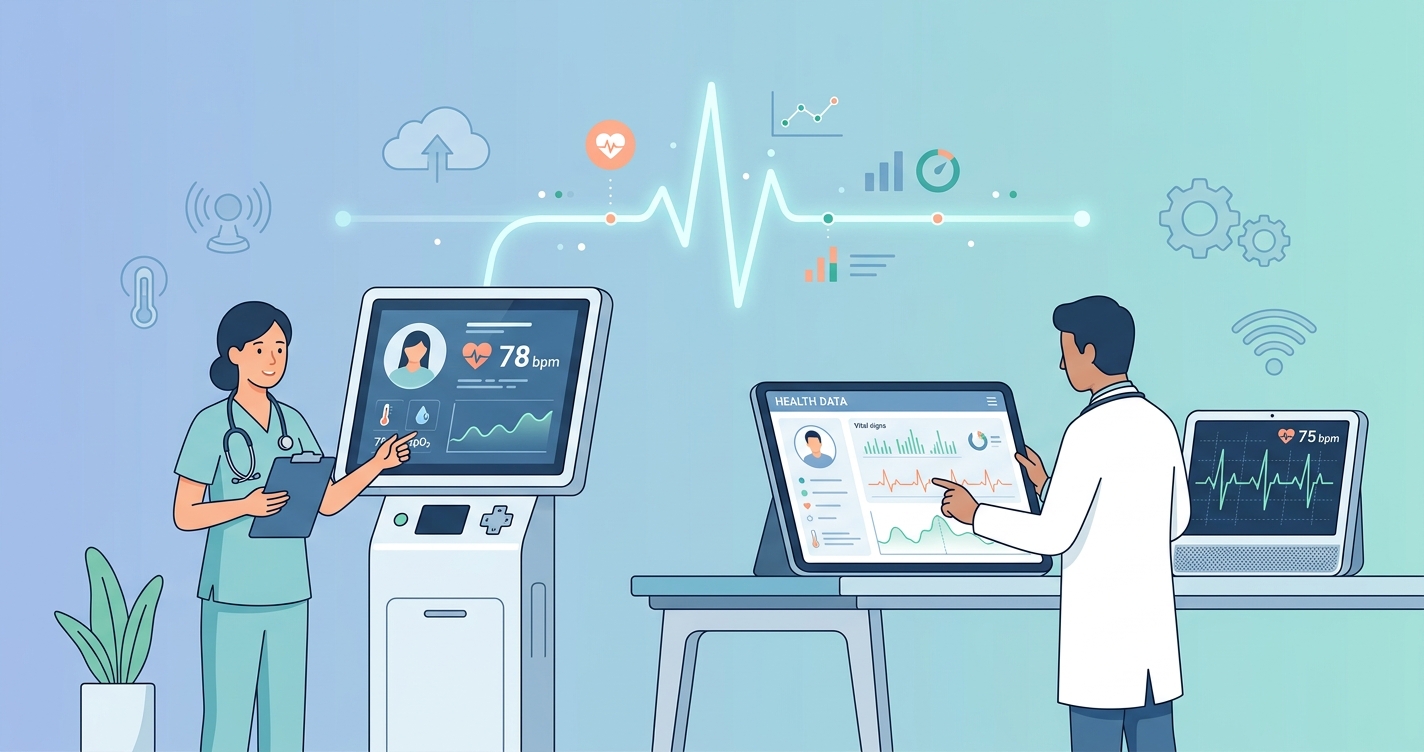
OEM health monitoring integration for device manufacturers usually gets pitched as a feature decision. In practice, it is a platform decision. Once a kiosk maker, tablet OEM, smart-display team, or medical device manufacturer decides to add camera-based health monitoring, the work spills into optics, compute, thermal design, software lifecycle controls, data handling, and go-to-market planning all at once. That is why the companies that move fastest here are not treating health monitoring as a bolt-on widget. They are treating it like a system capability that has to fit the device, the workflow, and the buyer.
“Many studies still lack performance testing, user-experience evaluation, and development standardization.” — Saksham Bhutani, Aymen Alian, Richard Ribon Fletcher, Hagen Bomberg, Urs Eichenberger, Carlo Menon, and Mohamed Elgendi, Vital signs-based healthcare kiosks for screening chronic and infectious diseases: a systematic review, 2025
OEM health monitoring integration for device manufacturers starts with architecture
For OEM teams, the real question is not whether contactless monitoring is interesting. That part is already settled. The better question is where the capability lives inside the product stack. M. A. M. Al-Quraan and colleagues at Jordan University of Science and Technology argued in their 2023 Electronics review that remote photoplethysmography on edge devices depends on lightweight processing, careful hardware selection, and robustness to lighting and motion. That sounds obvious until you look at how many product plans still begin with algorithm demos and end with a scramble around hardware constraints.
A manufacturer integrating health monitoring typically has to align five layers:
- camera and illumination behavior
- edge compute and memory headroom
- device software and update controls
- workflow integration with the OEM's host product
- commercial packaging, support, and regulatory ownership
If any one of those stays vague, the integration drags. I have seen this pattern in almost every embedded-health category: teams talk first about what can be measured and only later about where logs live, who owns alerts, or how the enclosure handles heat after eight hours of continuous duty.
| Integration layer | What OEM teams need to decide early | Why it matters |
|---|---|---|
| Sensor layer | RGB camera, lens position, lighting, face distance | Signal quality rises or falls here |
| Edge processing | CPU/GPU/NPU mix, RAM, local inference design | Determines latency and network dependence |
| Software layer | SDK boundaries, APIs, rollback, telemetry | Prevents “demo code” from becoming product debt |
| Workflow layer | UI prompts, session timing, result routing | Makes the feature usable in real environments |
| Commercial layer | Branding, support model, intended use, documentation | Shapes how the OEM can actually sell it |
Why OEMs are leaning toward connected monitoring features now
The broader medtech market is pushing device makers in this direction. Deloitte's 2024 Medical Device OEM Outlook framed connected care and remote monitoring as a core strategic shift, not a side category. McKinsey made a similar point in its software-as-a-medical-device work: medtech companies increasingly need to behave more like software companies, with stronger tech stacks, faster iteration, and clearer ownership of data and intelligence layers.
That shift matters for OEM integration because buyers no longer want isolated hardware. They want devices that can capture data, interpret it locally when possible, and fit into a broader operational workflow. For kiosk manufacturers, that may mean self-service screening. For tablet makers, it may mean a guided assessment session. For smart-display or appliance teams, it may mean passive daily check-ins. The form factor changes, but the demand pattern is the same.
There is also a practical reason manufacturers like OEM integration models: they do not have to build the whole signal-processing stack from scratch. They can integrate a specialized engine, then focus their own time on industrial design, workflow, serviceability, and channel strategy.
What a workable OEM integration model looks like
A lot of “health monitoring integration” language stays fluffy. It should not. A workable OEM model usually falls into one of four patterns.
| OEM model | Typical setup | Best fit |
|---|---|---|
| Embedded SDK | Monitoring stack runs on the device or edge module | Kiosks, tablets, fixed displays |
| Appliance integration | Monitoring engine is packaged with dedicated hardware and APIs | Clinical stations and managed enterprise deployments |
| Hybrid edge-cloud | First-pass processing happens locally, sync and fleet tools run centrally | Multi-site operators needing support visibility |
| White-label application layer | OEM uses prebuilt UI and branding controls on top of monitoring stack | Fast-launch products with limited software teams |
The strongest model depends on what the manufacturer actually sells. An OEM making rugged field hardware cares about offline tolerance and thermal behavior. A clinical-device company cares more about repeatability, documentation, and lifecycle controls. A consumer-adjacent brand may care most about onboarding friction and industrial design. Same core capability, different integration burden.
That is why rPPG for IoT integration architecture and edge computing for real-time vitals matter as reference points. They show that once monitoring moves from concept to product, edge decisions and device constraints become the story.
The hardest integration work is usually not the model
The literature keeps pointing in this direction. In their 2022 review, researchers from the University of California, San Diego and the University of California, Irvine described remote photoplethysmography for healthcare as promising across multiple settings, but sensitive to motion, lighting, camera quality, and subject variability. In other words, the issue for OEMs is rarely “can a paper show this works?” The issue is whether the host device can create conditions stable enough to use the capability reliably.
That pushes manufacturers toward a short list of non-glamorous integration priorities:
- exposure consistency and controlled lighting
- capture windows long enough for useful signal extraction
- enclosure and thermal design that avoid throttling
- clean handoff between host UI and health monitoring session
- support tooling for failed captures, retries, and diagnostics
This is where many product teams lose time. They assume the monitoring layer starts when the SDK is called. It actually starts much earlier, with camera placement, user positioning, and the device's ability to keep frame timing stable under load.
Camera and optics planning
Gerard de Haan of Philips and Vincent Jeanne of Eindhoven University of Technology have both been widely cited in the rPPG literature for showing how robust pulse extraction depends on signal quality choices that look mundane from the outside. Manufacturers do not need to become imaging labs, but they do need to stop treating the front camera as interchangeable hardware.
Edge processing and latency
Al-Quraan's 2023 review is useful here because it centers edge-device deployment rather than abstract algorithm accuracy. For OEM teams, local processing changes almost everything: privacy posture, bandwidth use, perceived responsiveness, and service cost. A device that can process signals on-box usually behaves more like an appliance and less like a fragile cloud demo.
Product lifecycle control
McKinsey's software-led medtech analysis makes a point that deserves more attention from embedded teams: once software becomes part of the product's clinical or operational value, the company needs a stronger release discipline. That means version control, rollback plans, traceability, and tighter coordination between hardware and software roadmaps.
Industry applications for OEM health monitoring integration
Clinical kiosks and self-service stations
This is still the cleanest use case. Fixed geometry, guided positioning, and stable power make kiosk deployments easier to engineer. It is no accident that Bhutani and colleagues found kiosk research heavily concentrated around screening and cardiovascular use cases. The hardware environment is just more manageable.
Tablets and mobile workstations
These products look simple until they move between lighting conditions, Wi-Fi policies, and battery states. OEMs in this category need tighter software controls and more careful performance budgeting than they often expect.
Smart displays and ambient devices
This category is interesting because the device already has a screen, camera, and household or clinical presence. The challenge is turning those ingredients into a repeatable workflow instead of an occasional gimmick.
Sector-specific embedded systems
Airports, retail clinics, senior living, field deployments, and border checkpoints all create different constraints. That is why sector-specific OEM planning matters more than generic “health monitoring enabled” messaging. A manufacturer building for assisted-living workflows should not copy the architecture of a retail self-check station and hope for the best.
Current research and evidence
The research base is strong enough to justify serious OEM planning, but it is also honest about what makes deployment hard.
Bhutani, Alian, Fletcher, Bomberg, Eichenberger, Menon, and Elgendi reviewed 36 studies on health kiosks published from 2013 through 2023. Blood pressure appeared most often, and cardiovascular disease detection drove 56 percent of the included projects. Their bigger point, though, was the one OEM teams should keep taped to the wall: performance testing and standardization are still inconsistent.
Al-Quraan and colleagues at Jordan University of Science and Technology argued in Electronics that edge-ready rPPG systems need optimized algorithms and hardware choices designed for constrained environments. That is basically the OEM integration brief in one sentence.
The 2022 UC San Diego and UC Irvine review on healthcare applications made the clinical opportunity clear while also stressing the operational variables that degrade performance in real environments. Motion artifacts, inconsistent lighting, and camera limitations are not side notes. They are central engineering concerns.
The market research lines up with the technical literature. Deloitte's 2024 OEM outlook and McKinsey's medtech software analysis both describe a market where device value is moving toward connected features, software layers, and data-enabled workflows. OEMs that can package monitoring as a dependable embedded capability will likely have a much clearer story than those still selling hardware as a static box.
The future of OEM health monitoring integration
The next few years will probably reward manufacturers that think like system integrators rather than component buyers. Health monitoring will keep spreading across kiosks, tablets, smart appliances, and vertical devices, but the winners will not be the teams with the flashiest spec sheet. They will be the ones that can answer boring but essential questions.
Where does processing happen? How is the session guided? What happens when capture fails? How is the software updated? Which team owns support? What data leaves the device?
Those questions sound operational because they are. And they are exactly what separates a productized OEM integration from a trade-show prototype.
I also expect more buyers to ask for configurable deployment models. Some manufacturers will want an SDK. Others will want a reference design, a tuned camera stack, and integration support around clinical kiosks or smart displays. The OEM vendor that can meet device makers where they actually build will have the stronger position.
Frequently Asked Questions
What does OEM health monitoring integration usually include?
Usually a mix of signal-capture software, APIs or SDKs, deployment guidance, and support for fitting the monitoring workflow into the host device's camera, compute, and user interface stack.
Is OEM integration mainly a software problem?
No. Software matters, but camera placement, lighting, thermal design, and workflow timing often decide whether the integration behaves well outside the lab.
Why do device manufacturers prefer edge-based health monitoring?
Because edge processing can lower latency, reduce bandwidth dependence, and keep raw image data on the device. That tends to improve both resilience and privacy posture.
Which devices are the best fit for OEM health monitoring integration?
Clinical kiosks, tablets, smart displays, and other fixed or semi-fixed devices are common starting points because they offer more control over positioning, lighting, and power.
For manufacturers evaluating where this capability fits, the real opportunity is not just adding another feature tile. It is building a device that can turn a camera session into a dependable health workflow. That is where solutions like Circadify's hardware integration program make sense: they give device teams a way to embed contactless monitoring into kiosks, tablets, and purpose-built systems without having to invent the full stack alone.