Can a hospital kiosk really read my vital signs from across the room?
Can a hospital kiosk really read vital signs from across the room? This analysis explains what camera-based kiosks can measure, where distance limits appear, and why workflow design matters.
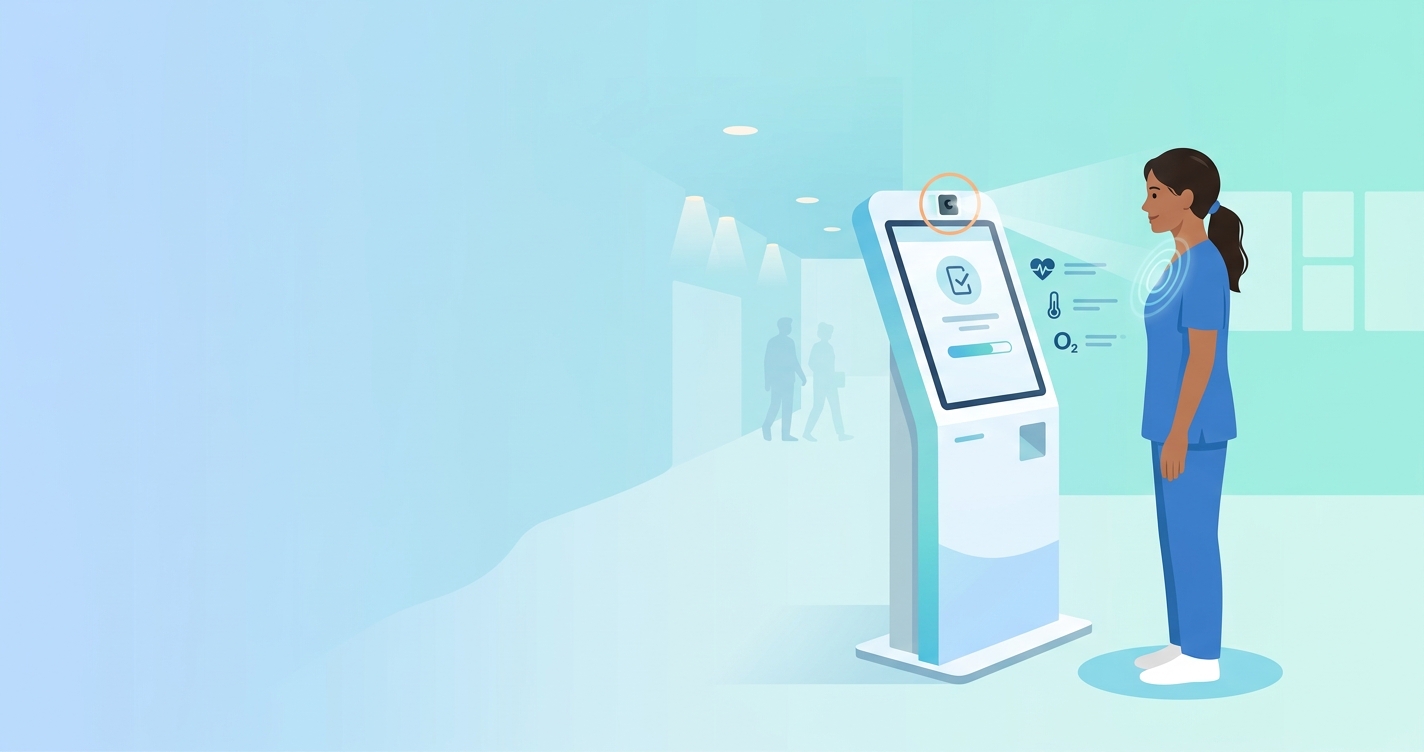
If you have walked into a hospital lobby lately and noticed a kiosk camera pointed toward the check-in area, the obvious question is whether that machine can actually read your vital signs from across the room. The short answer is: sometimes, but not in the way people imagine. Camera-based vital-sign systems can measure useful physiological signals without touching the patient, yet they work best in a controlled zone rather than from arbitrary distances across a crowded waiting room.
In a 2021 study on remote photoplethysmography conditions for telemedicine, Yuta Natsume and colleagues found that measurement quality improved with front lighting above 500 lux, frame rates above 30 fps, and minimal body motion.
What a hospital kiosk can really measure from a distance
When people hear "across the room," they often picture a kiosk making the same kind of measurement as a cuff, finger clip, or bedside monitor from several meters away while the patient is moving around. That is not how most real deployments work.
Most camera-based kiosks rely on remote photoplethysmography, or rPPG. The camera detects subtle color changes in facial skin that track blood-volume pulses. From that signal, software can estimate heart rate and sometimes respiratory rate, pulse-related trends, and other derived metrics. The catch is that the signal gets weaker as distance, motion, poor lighting, and camera angle problems stack up.
That means a hospital kiosk can often read useful vitals without touching you, but it usually needs you to stand or sit in a defined capture zone. In practice, that might be 40 to 100 centimeters from the camera for a kiosk, or roughly arm's length rather than "somewhere in the waiting room."
Comparison table: what "across the room" usually means in practice
| Scenario | Typical distance | What works well | What starts to break |
|---|---|---|---|
| Dedicated self-check-in kiosk | 0.4 to 1 meter | Heart rate, positioning guidance, short screening session | Signal drops if lighting or posture is poor |
| Mounted clinical tablet or smart display | 0.5 to 1.2 meters | Heart rate and some respiratory measurements | Motion and off-angle face position |
| Waiting-room ambient camera | 1.5 to 3 meters | Presence detection, rough positioning, workflow prompts | Reliable pulse extraction becomes much harder |
| Crowded room surveillance-style view | 3+ meters | Traffic flow, occupancy, queue analytics | Clinical-grade vital-sign capture is not realistic |
The honest answer for patients is that the kiosk does not need to touch you, but it usually still needs your cooperation.
Why distance is not the only variable in hospital kiosk vital-sign capture
Distance matters, but it is only one part of the measurement problem. Signal quality depends on whether the face fills enough of the frame, whether the lighting is stable, and whether the patient can hold still long enough for the system to collect a usable video window.
Natsume's 2021 telemedicine study is useful here because it did not just ask whether rPPG works. It looked at the conditions under which it works. The group found that front lighting above 500 lux and frame rates above 30 fps improved accuracy, while body motion sharply reduced signal quality. That lines up with how hospital kiosks are actually designed: fixed camera position, guided posture, and a short stationary capture period.
A newer 2025 algorithm-development study led by Yiong Huak Chan and colleagues at Singapore General Hospital pushed the evidence closer to clinical workflow. The team enrolled 200 preoperative patients and tested smartphone-based rPPG models for blood pressure and hemoglobin assessment in a real hospital setting. The broader lesson was not that every camera can replace every tool. It was that hospitals are actively evaluating camera-based measurement in structured care environments, where workflow control matters as much as raw algorithm performance.
Here is what usually determines whether the kiosk can read anything useful:
- Stable front-facing lighting
- Enough camera resolution on the patient's face
- Limited head and upper-body motion
- A short but sufficient capture window, often 15 to 30 seconds
- A workflow that tells the patient where to stand and when to hold still
That is why the phrase "across the room" can be misleading. A well-designed kiosk is not trying to read vitals from anywhere. It is trying to create a small, repeatable measurement zone inside a public space.
Industry applications for hospital and clinic kiosk deployments
The reason health systems are interested in this is straightforward: contactless capture can reduce friction at intake.
Check-in and triage workflows
In outpatient clinics and urgent care settings, a kiosk can collect baseline data before a nurse takes over. That may shorten intake time and help staff focus on exceptions rather than every routine measurement.
Pharmacy and retail-clinic screening stations
Retail clinics and pharmacy operators have similar incentives. A camera-based station avoids cuffs and clips for every screening interaction, which reduces cleaning steps and mechanical wear.
Hospital waiting-room routing
Hospitals are also exploring a more modest use case: not full diagnostic replacement, but early routing support. If a kiosk can capture heart rate, respiratory pattern, or other quick indicators while confirming identity and check-in status, the intake process becomes more informative before the patient reaches a staff member.
Current research and evidence
The research base is strong on one point and cautious on another.
The strong point is that camera-based physiological measurement is real. The 2021 study by Natsume and colleagues showed that rPPG accuracy is highly sensitive to measurement conditions, especially lighting, frame rate, and motion. That is exactly why kiosk manufacturers keep investing in guided positioning and controlled lighting rather than assuming any off-the-shelf webcam can do the job.
The cautious point is that unconstrained distance remains hard. Rouast and colleagues, in a 2018 review in Artificial Intelligence in Medicine, described rPPG as promising for non-contact health monitoring but emphasized the importance of controlled environments. The technology performs best when the system can constrain some variables instead of treating a busy room like a lab.
The 2025 Singapore General Hospital work by Chan and colleagues adds another signal the market is watching closely: hospitals want contactless capture in real workflows, not just research demos. Their preoperative study tested rPPG in a population with diverse skin tones and comorbidities, which is more relevant to care delivery than small homogeneous lab cohorts.
Taken together, the evidence suggests three practical conclusions:
- Yes, a kiosk can often capture useful pulse-based signals without touching the patient.
- No, that does not usually mean free-form measurement from several meters away.
- The winning deployments are likely to be semi-structured, where the kiosk guides the patient into a reliable capture zone.
The future of hospital kiosks with contactless vital signs
The next phase is less about magical long-range sensing and more about smarter embedded design.
Kiosks are likely to get better at combining positioning prompts, edge processing, and faster capture pipelines so patients spend less time standing still. Some systems will fuse camera input with other sensors. Others will use ambient detection only to help the patient line up before the actual measurement starts.
That is where embedded health platforms like Circadify fit. The commercial opportunity is not to claim that every camera in a building becomes a hospital monitor. It is to build reliable contactless measurement into kiosks, tablets, and check-in stations where the environment is controlled enough to support repeatable capture. More on that direction is available at Circadify.
Frequently asked questions
Can a hospital kiosk measure my heart rate without touching me?
Yes. Many camera-based kiosks use rPPG to estimate heart rate from subtle facial skin color changes. The system still works best when you are in the intended capture zone and holding still for a short measurement window.
Does "across the room" mean several meters away?
Usually no. In marketing language it can sound that way, but most practical kiosk deployments work at close range, often around arm's length to about a meter, where lighting and face visibility are more controlled.
Can a kiosk replace a blood-pressure cuff today?
Not across all workflows. Research groups, including the 2025 Singapore General Hospital team, are studying rPPG-based blood pressure estimation, but most production deployments still treat contactless capture as part of a broader screening workflow rather than a complete replacement for every traditional device.
Why do hospitals want camera-based kiosks in the first place?
Because they can reduce intake friction, lower contact-surface maintenance, and collect useful screening data earlier in the patient journey. For high-volume environments, that can improve throughput without adding the same level of mechanical complexity as contact-based stations.
If you are comparing kiosk design options, two related analyses on this site are worth reading: What Is a Self-Service Health Screening Kiosk? How to Build One and Embedded rPPG Hardware Platforms for Clinical Kiosks Compared.